
Beware the stampede of White Elephants

Like a romance scam, they are beautiful and promise everything yet deliver expensive disappointment. Here are the warning signs with plenty of real world examples.

Beware the stampede of White Elephants

Like a romance scam, they are beautiful and promise everything yet deliver expensive disappointment. Here are the warning signs with plenty of real world examples.


TRANSCRIPT: 

(This transcript is derived from an automated process.  The video recording is authoritative.)  


Professor Scott Prasser:

Thanks, Jewel. I just want to say we really should be really thankful that Voting Matters, runs and operates because no one else is doing this in Brisbane. It's a fantastic thing that's happening. There's some organisations in Sydney that get million dollar donation from the big end of town. We know Jewel doesn't get donation from the big end of town as far as I know. And it's really fantastic that we run these sort of events and we have a wide range of speakers.

Now, my topic is white elephant projects. That's the book. It's called A Stampede. So many of them, and we'll talk about what they are in a minute, what they are, how we get them, why should we be concerned about them and can we do something about getting rid of them or something. So here's some of the issues we'll talk about white elephant projects.
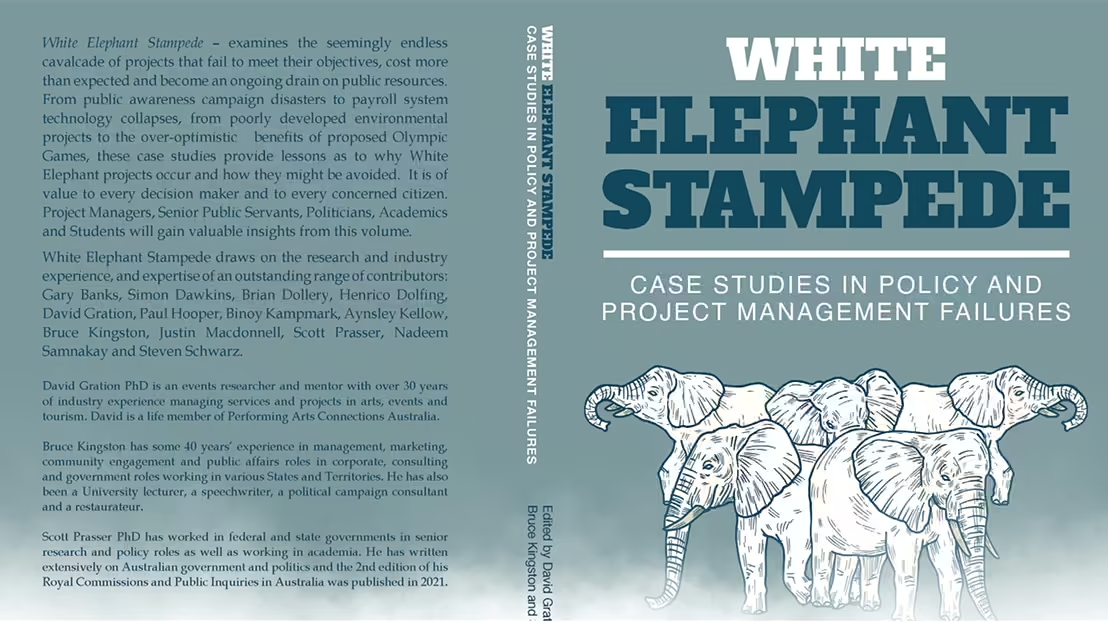
Now, a lot of people may like to know where the term white elephant comes from. It's got nothing to do with white elephant sails or trash sales at all. This is what a white elephant project is. It's a possession that is useless or troublesome, especially that it was expensive to maintain or difficult to dispose of. A white elephant project becomes so expensive, no one wants to have it back or buy it. And where does it come from? It comes from Thailand. So Thailand's one of the few countries in Asia, which wasn't colonised by Europeans, had a king. If you watch the movie, the King and I, that's where that sort of thing, and Ty and I quite liked Thai people. And basically what happened was if you were found with your hands in the till of the king's treasure, you could have your hands cut off and other bits cut off as well.

But in Thailand, they're very kind people. The king would give you a present, he would give you a white elephant. If you go to Thailand, you'll see elephants are used to do work, but a white elephant is sacred. You can't work it, but you've got to maintain it because the king's given it to you as a gift, which means it becomes a burden to you. It basically sends people broke. And of course everyone sees that you've got the white elephant, which means you've done something wrong, but you've been honoured by the king of this beautiful white elephant. So a white elephant is something which is beautiful but useless. Okay? So that's where the whole term comes from and I like it a lot. And these are the characteristics of a white elephant. Now we're talking about public projects only. We're not talking private enterprise projects because if investors are stupid enough to invest in something that doesn't make a buck, that's their problem.

As long as the government doesn't bail it out, okay? That's why I have a problem, okay? Right. There's a famous story about I drive English cars, as you may or may not know. And when British Leyland was running at losses and making cars that no one wanted to buy, they went to the British government who gave it billions and billions of pounds to keep going. Now, over in a place called Germany, Germans used to make a car called the Beatle, and it stopped being a successful car. Volkswagen went to Helmut Schmidt, the socialist chancellor, and said, will you give us some money to balance out? They said, no, we're not going to give you one mark. Okay, go and start building cars that people want to buy. We will put some money for retraining the people you're going to have to sack. You're going to have to trim down your workforce.

And what led that to that led to the Volkswagen Gulf. Okay? That's what that led to. So Volkswagen is still going. British Leyland doesn't exist. Okay? There's a sort of an example. So a white elephant project talks big but doesn't deliver. Okay, we're going to do these things. It's going to be the greatest museum or the greatest building or the greatest project. And it just doesn't deliver is usually this is the big touch. It costs more than it was supposed to cost. Beware of government estimates of cost, which you are seeing all the time. And I'm going to give you some examples as we move on. It might produce some benefits, but they don't last or the not, they don't cover the cost. They usually will have some benefit, but they don't cover the cost. And governments don't like to admit they've made a mistake.

So they patch it up and keep it going and put more money into it like keeping an old car on the road and on and on it goes. And it just becomes a bigger and bigger problem. And then the other thing about a white elephant project, it becomes clear at the time, not 10 years later, that this is a disaster. It becomes pretty clear to either even before it happened, this is going to be a disaster. I'm sure you can think of some as you come along. There were other things they could have done and it's usually made in a democracy by cabinet and everyone goes along with it. Okay? So here are some warning signs about a white elephant is on its way. These are things I think you should when you hear these sort of things. Beware. Beware. Danger. Danger. They usually don't have a business case. Why do you want a business case? Well, this is a great idea, okay? Don't worry about having a business case or is anyone, so "we'll build it and they will come" syndrome, okay? It's usually rushed. Look, this is so important. We can't go through the normal processes. This is a really urgent thing before an election or something like that.

It's usually secret. We don't get the full facts. You worry about it. It's all under control. We know it's going to happen. It's perfectly all right. And it's not till later when the costings about the Gabba, it's only going to be a billion dollars, only a billion dollars, only a billion dollars. And then the quirk reports that it's going to cost $3 billion. It's 300% out. Okay? See what I mean? And beware when politicians talk about visions or landmark or iconic structures, it means it's going to be ugly. But we've got respect to architects and so on, okay? This is going to be an iconic project really. I mean, one of my favourite ugly projects, if you ever go to Melbourne, I think one of the ugliest constructions is Federation Square. I think it looks like St. Hitler would've built or something along the way. It's awful.
Usually the goals are very fuzzy. It is going to be going to be a tourism centre or is it going to be something else? Is it going to attract people? Is it going to make something? The goals are all mixed up. They don't know what its goals are usually in business. What's your aim of business to make a buck? You know what it's all about. Okay? Costings are unclear, and usually when a project start to get delayed, danger, danger delays mean more cost. It was harder than they thought it was going to be. Okay? The big rail loop in Victoria, which is mushrooming inside delays and delays and so on, a cross river rail and so on, it costs more. And the original reasons why you had the project start to change that the circumstances have changed. Why we're doing it has changed. The government has changed and people are left with this sort of shambles.

Now, there's some other indicators. This is a white elephant project. They start asking, look, only we had another a hundred million dollars. It'll work, right? Okay. And if you notice today, the amount of money that is turned around about what we need, it's like unfortunately during COVID, governments went berserk with money. Okay? Federal parliament passed $300 billion worth of funding. In 24 hours well be okay. So usually more with money, the costs keep rising and the thing doesn't work properly. There's something wrong, it just doesn't quite work and performance is poor. So all those things, lots of teething problems. And look, we really weren't building it to be a tourism centre. We were building it for being an iconic building for people to admire or something like that. Those sort of issues is what comes out. So in the book, this book, we've got a number of case studies and we talk about the Queensland payroll scandal for the Queensland Health Department.

Now that cost, there was a Royal Commission into that cost millions, they decided a new payroll system. So some people got overpaid, some people got underpaid, and some people didn't get paid at all, right? And so it cost millions of dollars to fix. They had to bring consultants in from all sorts of those fancy consulting firms. They might mention their names and they must have thought this is fantastic. To get that to work took so much effort. That was a white elephant sort of thing. COVIDsafe. Did anyone here use COVIDsafe? Now, being a difficult person that I am, I refuse to sign up to. The government sent me, okay? Now, a lot of my friends said, oh, Scott, you're really letting the side down now. It was a disaster, okay? Few people signed up to it, it cost millions of dollars and it basically just faded away a waste of everyone's time.

The other thing we've got in the book is tax concessions for the film industry. The idea is you make a film and it makes a loss and you get money back. You don't make a film that people want to see. You make a film that people don't come to, and that's going to boost the film industry. And that's been a monumental ripoff of the taxpayer. The taxpayer funds these things, desalination plants.

Now Russell talked about tanks, water tanks. Now my next door neighbour put in a water tank during the so-called drought. Now we didn't, the Prassers didn't do this. I had this very odd notion that having paid rates for 35 years, that I thought the government should supply water to me. Okay? I had this, I know it's an outdated sort of notion. I'm not putting in a tank. And of course I also had the view or droughts break.

And guess what? Floods. Okay, it broke. Okay, so the next one, node's got a wonderful tank, which they probably don't use and we haven't got one, and we're better off financially. So desalination plant is the craziest, craziest idea. They've got them in Victoria and I think New South Wales. And this uses vast amounts of power, energy, and they're very expensive to run. And just remember, we haven't built a dam in Queensland for a long time and we've had an increase of population by 50%. And the desalination plant is a really, really bad idea. Now, Saudi Arabia, where my son is working, they've got desalination plant, but they've also got lots and lots and lots of money they like to waste so they can do it. And it is a desert. It is a desert, but Queensland is not a desert. So desalination plants are really, really bad and very expensive.

Also, they may have to maintain them to keep them in case of the day where we don't have rain or something. Olympic games now, on average in the book test that most Olympic games have run at a loss. I dunno about the lowest, about the Paris one, but most Olympic games run the Los Angeles one didn't one, and the American one didn't most run at a loss. And they become more and more expensive because we have more and more sports in them requiring more and more facilities, which are never used again. Right? Okay. Now I have to admit, I don't follow sport. I did like watching Olympic games and so on. I would've liked to have seen some other countries win something. Occasionally I thought watching Olympic games, there was no other team except Australia in it. But Olympic games are really, really expensive things.
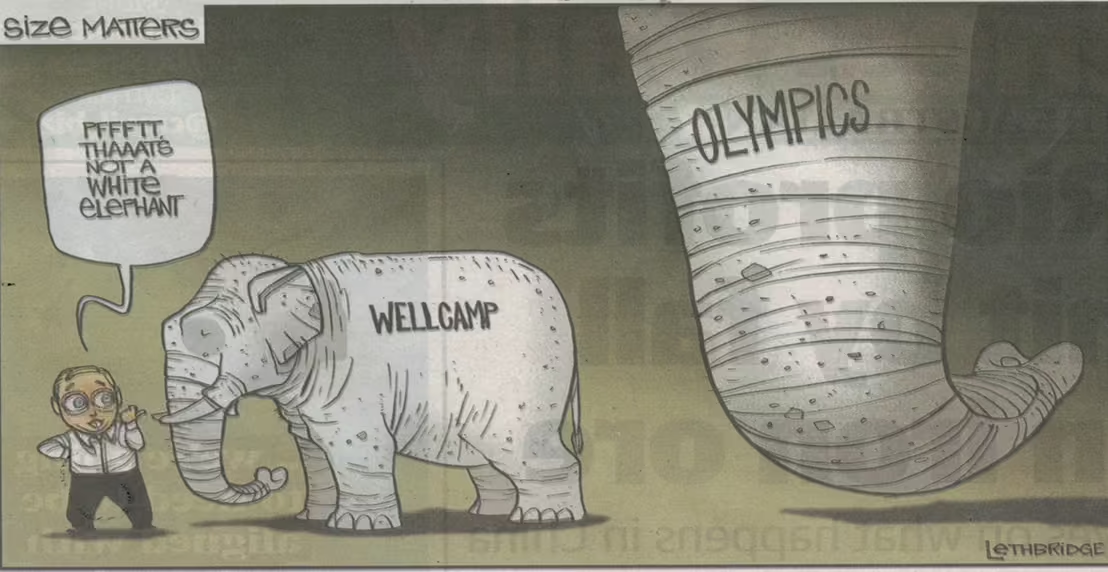
Now we are having Olympic games. I think in 2032, we won the prize, but we were the only competitor. Now that worries me a lot. When you win the prize and you're the only competitor, that means no one else wanted it. Okay? And we're now been into that for what, three or four years? Without being partisan or political, the government, I don't understand why government hasn't set up the right processes to manage this from the word go. It's a complete shambles. Now, Graham Quirk, the former Lord mayor of Brisbane, did a very good report. I advise you to read it, looking at about the Gabba and the other one further out and then should build a new stadium at Victoria Park, which the current government said they would follow all the recommendations, lock, stock, and barrel, except it's just been locked and not the stock and barrel.

Okay? So we're still going ahead with one thing, which they said was crazy. We're not going to gather. And the LNP opposition, we don't quite know what they do. They're going to accept another review into the review to find out what to do. Time is ticking away. Now, the thing about Olympic games, the ones that are successful, is the sooner you start it and organise it and plan it, the greater the chance of success. This is normal practise. It's like writing an assignment. You can either write the assignment the night beforehand, it won't be very good, or you can plan it four weeks ahead. Okay? Now here we are and we still haven't got it resolved. And I think on the eve of an election, I don't think government should been making too many decisions. They should have made 'em three years ago when they won the prize. So my prediction is going to be, my prediction is, and if we're still going in 2032, you can call me back. If I'm still here, it will be expensive. It will cost more than the estimates. It will not generate the amount of tourism dollars that people think the Sydney one didn't.

It didn't generate business for them too. And what worries me about these projects, these iconic projects, it consumes government attention. It consumes public service attention, and it takes their attention away from other and more important things like building roads or bridges or things like that that we need. And everyone gets caught up. Now, business loves these things because they get on the committees and it's going to bring some people in and that's, they're going to get some contracts, building things and making things and so on. I think that they're really disasters. Okay, so I'm going to start my campaign, say no to the Olympics, but we'll see what happens. The Gabba stadium, you know about is going to be $1 billion and between 3 billion and so on, and the figures were done on the back of an envelope or something like that.

Local government amalgamations is also in the book.

Local government amalgamations. We used to have 800 local governments in Australia. We're now down to about 500, okay? Now, local governments are not in the constitution. They can be abolished by state government like that, okay? Beattie government amalgamated them. They're all amalgamated and put together because they're supposed to be a cost saving. They'd be more efficient, bigger is better, but the evidence is they end up costing more people redundancies. All the committee meetings to bring it together. The local people feel disenfranchised because the bigger council doesn't recognise them. So luck go and Melbourne are another thing. Australia wide have never delivered the cost efficiencies that they're supposed to, never delivered them defence projects. Now look, just pick up, we buy helicopters that don't fly tanks tank. We stupidly bought the Abraham's American tank, which uses 400 gallons per kilometre or something. And it's too big to go across most of our bridges.

Without showing my origin, we should have bought the German leopard tank, which was much better. And you can take out the engine 15 minutes, you can do 70 kilometres an hour or something. So if you want to look for white elephant projects, pick up any auditor general report and read about the mistakes in the defence industry alone, okay? They were burying some helicopter, weren't they recently? Did you see that? They're bury, they're burying helicopters. I mean really? So lots of waste in the defence area and the procurement area is just horrendous and no one seems to worry about. So look for that. Another one in the thing is the submarines. The Collins class submarine is so good. They don't let it go underwater. They dunno. It's going to come back up. A terrific project this is, and they can't get enough sailors to go on it and therefore they don't use it and so on.

And I think the AUKUS thing is stupidest. The stupidest idea I've ever, we're going to get a submarine in 2040 or 2030 or something or other. We should have brought the U-boats from Germany. They would've cost 12 billion bucks coming and kit form. The Germans would've come to South Australian, train some people to put some bolts together and we would have some submarines who operating now. But we've gone down this nuclear thing, which I'm not against nuclear, but it's too long. It's too long to get a defence system operating China would've invaded us by the time this is all over. Don't invade. We're waiting for the submarines to arrive. Okay? Right? So there we are. There's some sort of things I'm talking about. So now here's the Victoria. Now if you want to go to a place, wasting money has now got the biggest deficit of state governments.

Congratulations. Thanks to Mr. Andrews. And this is from the Australian. Last week, Victorian transport infrastructure minister, Mr. Pearson announced that taxpayer tax payers, taxpayers will pay an additional $837 million. It's so little. It's so little. What are we worried about for cost blowouts to Melbourne Metro Tunnel Project. Okay, across Yara partnerships who are building the metro tunnel are to contribute something comparable amount. It means that the total cost to build a tunnel will be around $15 billion, right? By the way, the federal government spends about 15 billion on school education. There's an comparison. Victoria's contribution would be fit 13.5. Mr. Pearson, the minister, wait for this. There is a number of reasons. Oh, we're waiting for it. We're waiting for the reasons. Here they are. Oh, COVID, they obviously affected the building site, right? The building stock struck, must have got COVID as well or something, okay? And the war in Ukraine must have been all those rockets from Russia bombing Victoria.

Now this is just nonsense, isn't it? Right? It basically showing appalling planning and a complete disregard of the taxpayer's dollar. And Victoria, if you go down to Melbourne, it's like a construction site everywhere with this crazy rail loop, which is going to cost $200 billion. And you'll notice also the state in Queensland without being political was saying, look, all this extra money we're spending for the election, I mean we're spending for you so we can win the election. It's got to be an extra $9 billion. We're just going to borrow it. So Queensland has got nothing to worry about, but when you borrow money, you've got to pay interest back and our interest bill, and when you have an increasing interest bill, you can't do other things anyway. Beware. Now some other camps, Wellcamp, you want to know about Wellcamp beautifully designed. No one that went there. Melbourne Road, I talked about the Tasmanian football saving $730 million for what a game played five times a year or something.

I don't think government should build facilities for professional sports. It's professional sports. They get money from sponsors and people to go and watch them. And if you want to go and do that, then you pay the bill. Scott doesn't watch sport and I couldn't give a stuff about the AFL or any other thing. Go and pay for it yourself. The federal government's going to get involved in this. The Brisbane Olympics, the NDIS.

The NDIS is on the verge of being more, costing more than all the money we spend on aged care. It's going to cost more than all the money we spend on schools, federal and state and universities. I mean, universities are another issue where they're white elephants too. NDIS is out of control, right? Okay. And there's never a proper cost benefit analysis about it. I'm not saying there are not some need, but it's out of control. And that's what happens. And there's probably others you can think of. You might like to think of.

Now, last night or night before, I was watching SBS TV being the good multicultural person that I am, which has some fantastic programmes on the royal family. I can never quite get this, but this last night they had a programme on the Concord. You want to know about the Concord plane? Beautiful. Okay. It was basically the Europeans beating the Americans at their own game of building a supersonic plane. Problem: was there a market for it?

There wasn't. They only sold 14, right? It was super duper technology. It carried too few people. Every time it took off, it lost money. It was run super, super jets and extraordinarily high maintenance bill. The way to go was the jumbo type stuff that Boeing went down the track of. It did produce lots of technology and lots of research and probably kickstarted the European plane building industry, but a monumental flying white elephants, okay? Unfortunately, it had that terrible accident and people died, but it was nevertheless a white elephant project. Now, I shouldn't mention, if you go to Sydney, there's one big white elephant project. What is it?

Sydney Opera House. Now I know I should wash my mouth out. Now I'm uncultured. Now it is 2000% over budget. 2000%. It's very expensive to maintain tiles keep falling off. It was a design that no one knew how to build problem. They had to sack the architect. I think the original cost was $7 million, by the way. It acoustically was a disaster. They had to redesign the thing to make it work. Now, it is beautiful and it is iconic and so on, and I know it's the symbol of Sydney and the bridge, I suppose. But we don't mention white elephant and the Opera House anymore. But it is technically a white elephant. It used to be held up in textbooks as how not to do a project, how not to do a project sort of thing.
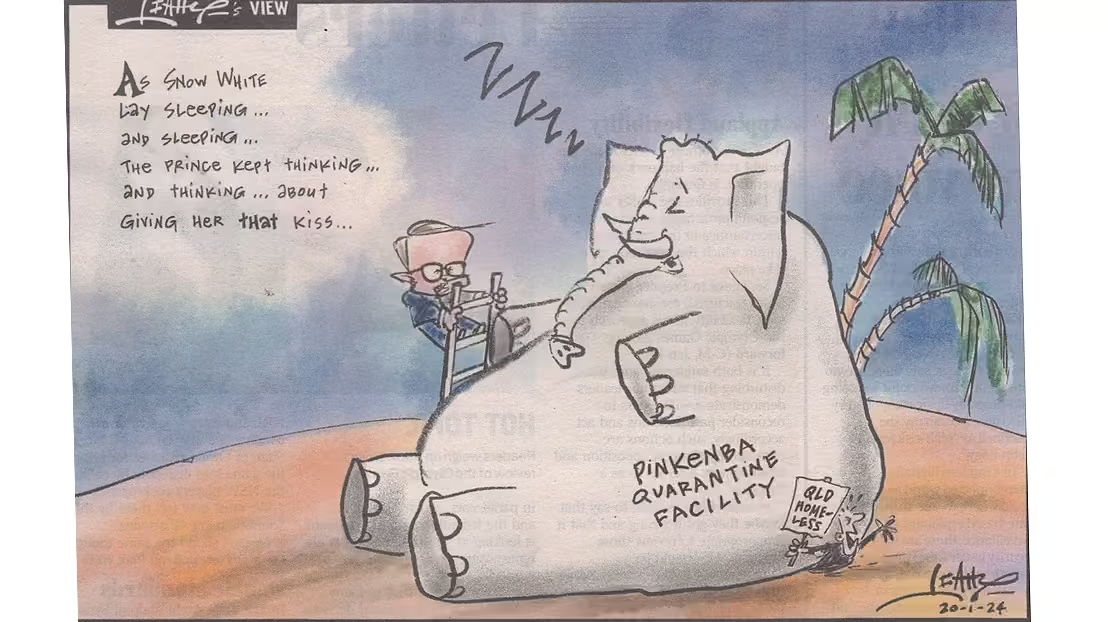
Here's my white elephant, the Pinkenba quarantine facility. Again, what happened there? Rushed decision making. We rushed to a solution before defining what's the problem? Okay? We know a lot of things were done during COVID, which had no evidence base to them, and that's now coming out all the time. There's quite this article in Sydney Morning Herald. People have been saying a lot of things that happen were unnecessary and costly. Washing your hands of what was a waste of time because it's an airborne disease. It took the WHO two years to admit it. Thanks to a professor at QUT here, professor Liska, A lot of things that were done were really disastrous.

I'm in the Swedish camp. They didn't have any lockdowns, they didn't have any compulsory mask wearing. People were allowed to come and go in the country as they wanted to. And their big mistake was not looking after the aged care properly. They had outbreak of that. That's another issue. So there we are, my elephants there, we've got the Wellcamp, and then we've got the Olympics coming in the background sort of thing. Okay? Beware. Beware. Okay, now why do we have these white elephant? Are people stupid? Are governments stupid?

Can't be true. You all know who Nikita Christov is. You all know who your sort of educated people. Now, he had a wonderful saying when he was premier of the Soviet Union, that politicians of the same the world over, they build a bridge where there is no river. Because even in the Soviet Union, they did symbolic things like trying to send a man to the moon and so on. So politicians often do things and you just can't understand why they're doing certain things. Now, I'm very proud. I work for federal government, I'm very proud. I saved you all $50 million, okay? So please, unfortunately, I've not been nominated for a knighthood or for an AM or OIM or AO or anything like that at all. But I saved your $50 million because I slowed down what I thought was a stupid decision. So the public service and I, Scott, what are we going to do about this? We are going to slow it down. The brief will stay in my intro an extra couple of weeks. I'll wait for the minister to go away before I put it in the minister's tray.

We'll get another cost of analysis, another six weeks and so on. I won't tell you what the project was, but it was very dear to the minister at the time and very dear to the government at the time, it was going to win elections, not about was it a good decision, it's going to win the seat. But what happened was it got so late, the Prime Minister's office cancelled it. The member of parliament who they was paying to help won the seat anyway, so we didn't have to spend $50 million to win the seat. And that's the story. But that's one of the problems. It's what's going on inside the black box. That's the problem, okay? That's why we keep having these things. Firstly, we've got an over expectations of what government should do and government have got an over explanation of what they can do.

When I was in government, the question I would ask, can we do this? Oh, well it might be a bit hard, Scott. We rush too often into expecting government to do things for us. A bit like what Russell's talking about, telling us what we should or should not do, what we should and shouldn't look at. Okay? So governments have gotten involved in more and more areas of our lives and that leads to the mistakes that you get. We also have what is called the sunk cost syndrome. The best way to describe this is if you've got an old car and you've just spent $3,000 doing the engine up and you drive down the road and the gearbox falls out, what should you do? You should take it to the dump. But you say to yourself, I've just spent $3,000. How much would it cost to fix the gearbox?

Another $2,000? Oh, well that's not too bad. I've fed $5,000 to keep the car. That's sunk cost. You keep putting money into it. Or the other way of saying, if you ever go to the movies and you're there for about half an hour and the movie's crap, you should walk out. But you say, no, I've paid $15. I'm going to sit for the next two and a half hours and watch this absolute garbage that sunk costs. You should walk out because your time is valuable. So some cost syndrome. So governments have get a project going and they keep pouring the bucks into it to make it work, okay? Right? Robo debt is a little bit like that. That should have been closed down because someone surely must have known it was illegal. A bit of a problem. Is it illegal? Okay, so political. Look, you're seeing election time. Election time is wonderful to watch all these things in action. We expect government look, there's a problem. Jimmy fell over at the front. Oh look, government should do something about that footpath.

So we expect government to do something and governments like to be doing something, doing something. And what's interesting in government is what I call the policy merry-go-round. We keep going around repeating the same thing over and over again about thing. We tried it and we'd come back. So there's expectation of government to be seen to be doing something. And also at election time, what's going on is a bidding process. It's like an auction, okay? I promise to give you free transport. I promising you free transport too, plus a lollipop. Okay? Right? I promise to make daycare completely free. I promise to make daycare free too. You've got this competition going on which keeps egging up public spending all the time and really government doing things that government never used to do. The other problem going on is the politicalization of the public service. All public services in Australia, federal and state, more state than federal are politicised.

That is, we don't have a permanent public service. Now, back in the Joe days, did I say this? This is going to be unpopular. We had a permanent public service that is, see, Leo Hilter, head of treasury was permanent. Sid Schubert, the coordinator general was permanent. And when Joe came up with his crazy ideas, they would say, no, premier, you can't have it. And I know these gentlemen, I worked in the state public service, so he had a public, that's why Queensland in that period ran budget surpluses. Joe wanted a state zoo. We didn't get a state zoo. He wanted to have water cars. Maybe that's the right thing. We didn't get water cars. So there's lots of things we didn't get. There was a bit of politics going on about where they spent some money that politics, but it stopped us from going down some of those crazy things.

The public service will say, no minister, that's a really dumb idea. Now these days, all the top levels of the public service are all on contract, right? Three, five years. Now, if you're on contract and the minister says, I want this, what are you going to say? Wonderful idea minister. Really fantastic. Look, I can't wait to implement the latest crazy, I mean the latest idea from your office, okay? Because it's politicised up to a contract. And the fact that we've got a former labour member, a former labour staffer, and a former labour official as head of the premier's department in Queensland is absolutely extraordinary. Right Now, if I was Mr. Christopher Foley and I won on Saturday night, I'd just ring this gentleman up and say, don't bother coming into work on Monday. Alright? Okay. So what happens now when there's a change of government, there's a change of the senior public service.

And the problem with that is some good people do lose their jobs unfairly. And also we lose memory. We lose organisational memory. So once upon a time, the public service could say, look, we tried that 10 years ago. Really stupid idea. We dig out the file these days, lot of public, senior public servants. They been there three or five years on a contract. They dunno what happened 10 years ago. And they're afraid to say what we call frank and fearless advice. That's a really stupid idea. Now, my view of the world is this. I worked under three governments, the Peja Peterson government, the Borage government, and the Beaty government, okay? Right? Three different governments. My view of the world was my job was to protect the minister or the premier. That is to tell them what I really thought so they wouldn't get into trouble.

Okay? That's how I operated and that's how I did it. But not everyone followed that sort of model. So what we've got now is the Olympic Games is the example. How did the public service allow such an appalling process to occur? Because they were doing the political bidding of the government of the day to rush things through and so on. And so everywhere we've got our public service and other places are being politicised and that's why projects get out control. So we've got organisational amnesia and then we've got a thing you may not have heard of canine economics. That is we spend more money that boosts the economy, that creates employment. And Mr. Kanes, who was an economist in England, brilliant sort of guy, he didn't say you should spend the money and it useful if you just dig holes and you create employment, that's a good thing.

Now what's happened is governments use that economics to justify spending. Governments love to spend money. Now, what's also happened in the last few years, a new theory is developed called Modern Monetary Theory coming out of universities. And what this says, look, all that stuff about balanced budgets, worrying about debt, it's irrelevant. Governments can spend as much as they want, borrow as much as they want. Governments can never be declared bankrupt. So don't you worry about spending money and debt. So that sort of theory has taken over a lot of thinking where once upon time, treasury would say, maybe we should trim things back a bit. Now, I was involved in school funding. One of the SI worked for in Canberra, and the story I like to tell is that we were having this great debate about remodelling it and developing more spending and so on to suit all sorts of things.

And the first brief that came up from the department proposed that the spending would be an extra 4 billion and I hit the roof 4 billion extra. I rang up the department and they said, Scott, don't you worry about it. You've seen nothing yet. Okay? Right. The next brief that came up in January, 2017 was $14.4 billion more. This is the way to satisfy everyone. Wow. $14 billion more. And then the next brief that came up, it was 18.6 billion, extra over 10 years, 250 million billion dollars. Eventually it settled at 25 billion. Now through that whole process, treasury did not raise one objection about what is the extra money going to be used for? Is it going to improve education performance? Australia's education performance is going like that, by the way. Okay? So we were spending extra money to satisfy all the interest groups, but no one in treasury said, what is this going to make any difference to?

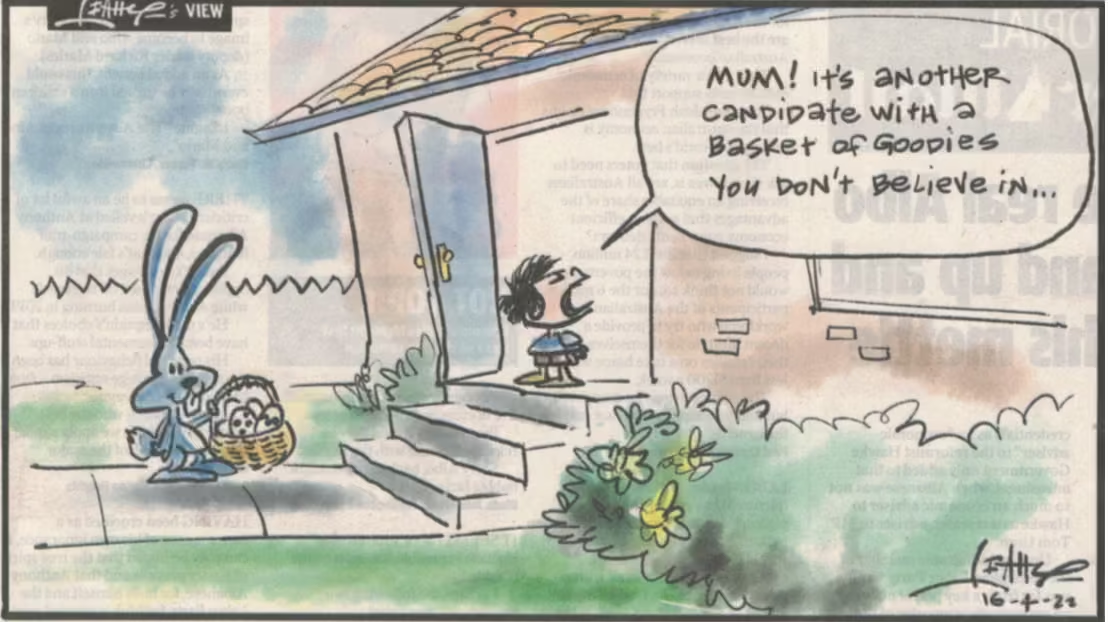
Education performance. Okay, so this is sort of an example of that problem, okay? Promises. Here's the sort of Easter bunny. It's just like election time. Hey mum, another candidate with a basket of goodies. You won't believe it. I mean, you can't believe what's going on at the moment, can you? Right? Okay. You just can't believe it. By the way, in 1957, the last year of the labour government, we were going to have a state petrol station stationed. It was going to be the petrol was going to come from Taiwan. It was going to be called Dim Sim petrol, okay? The labour government was the one behind it. It was because the local producers in Australia were not selling petrol at the price that the Queensland go wanted to do. And so they attempted to set up their own petrol fower idea. Does it sound familiar from somewhere?

Okay, there we are. Nothing new under the sun. So should we care? And what can be done? Okay, we should care about all this because waste resources. So just like if you waste blow money on the race horses and you've got less money for paying your bills, that's bad. That's bad. Governments aren't not that different. Really, it is allocating resources on things that have low returns or poor returns. We could reinvest that money more effectively and so on. Opportunity cost. Opportunity cost is the basis of all economics that if you spend X dollars on that, that means you've got less dollars to spend on that opportunity costs. There's only so much to go around and it distracts attention from the important thing. The Olympic games, we're going to be talking about roadblocks and committees and facilities and inclusiveness and all these things. It's going to go take up so much energy when maybe some other things might be more important that make productive Queensland.

And the other thing, as I said before, once governments start, they stick at it. They don't want to climb down and say, we were wrong. This was a dumb idea. So it locks us into those things. They go for the big project of the big glamour project when actually it's little things that make it often make a difference, that make a difference. This an example today, the l and p released an thing, their first statement in four years on education, which is the second biggest spending item in Queensland budget, right? Second biggest spending item, right? Queensland education performance performs worse than some other places, better than some other places. Okay? The best performing part of Australian education is a CTY. Socioeconomically, well paid, well educated, but it's way behind Singapore. It is way Australia's best education is way behind Singapore. Okay? Alright. So today, what was the promise? More teachers and more teacher aids.

That's not evidence-based, okay? What we want is better teachers and better trained teachers who can teach phonics and all that sort of stuff and use direct instruction, which is the evidence. We don't hear that talk. So we're talking about spending more. This will keep the teacher's union happy, right? More members means more power where the teacher's union give their money to the A LP. Okay? So this is really missing the boat. It's missing the boat on this issue. So should we care? Things keep repeated. Now, some good news, some good news in 2022 is that when we got the 2021 when we won the Olympics, the month we won the Olympics, the Queensland government abolished in Queensland, a thing called the productivity commission. The productivity commission, which is copied off the federal one, is an independent body which does costing on projects, right? Is this a coincidence?

No, it can't be surely, but if you only evil people think back. Okay? So we abolish the productivity commission, the same almost month that we won the Olympic prize that no one wanted. Okay? So we had no independent body to put the business case through a mill, okay? Now the l and p had to be congratulate because they promised to bring back the productivity commission, but I hope they bring back an independent one, not some hack being put in the role. So we'll see what happens. So look, we should care about these things. Are there some solutions? We've got to fix up the black box. We've got to get the public service to be professional and independent and permanent and recruited on the basis of merit. Not because you're a left-hander or whatever it may be or so on. We want to have greater transparency in decision making.

What is this going to cost? Okay, tell us. Now we need the public, the productivity commission. So that can tell the public, I don't mind governments doing political decisions. I just want to know the cost of them and then we can decide whether we accept it. We could have, in some countries they've got infrastructure Z. So there's people who really control the infrastructure before they get out of way. So we don't go off on building all sorts of crazy things. We need much better public consultation and not pretend consultation, right? In politics, there's a thing called speaking truth to power. That is the public servant telling the minister the truth. That's a really dumb idea, minister. I have another saying of the government should be speaking truth to the people. What is this? Stop all the programme statements. All the ministers say the same thing.

Tell us what's the real problem and admit that you can't fix it, you can't fix it. Something we can't fix, okay? Or to fix it would be three quarters of the budget or something like that. Okay? Big truth to the people. And I have this great belief. I have a great belief that sometimes some politicians have got the skill, whether it sometimes poor Keating, sometimes John Howard to go and say, we're going to do X, but before we do X, we're going to go an election and you can either throw us out or put us in. Okay? That's the sort of discussion I want to have rather than this, oh, we didn't mention it during the election campaign. We're going to do it now. I want the ministers to front up and tell us what's the problem. And I know the media are onto them and eating them and attacking them all the time.

But if we had more people, governments talking truth to the people, we would all probably grow up a bit and have much more better discussions about issues. I'm going to stop all this pretend game going on. I want some political restraint. Now I'm a bit like Russell. Russell has designed three houses for us. They're all standing, they're all still standing, but he tells me I wouldn't be allowed to build them again. And one you've seen. And I think I want governments to stop getting in our lives a bit. I don't mean I don't want them to stop. I want to rest Young people who are attacking people. Of course that's got to be stopped, but they're interfering in so many things that costs money and sometimes it doesn't work. That's why we've got white elephant projects. And on that note, there's a book and it's a book which we had so many white old from projects to choose from. We could have had several books and maybe we'll do another one, but just keep your eye open for them. There's a stampede out there. Be careful you don't get knocked over in the rush out there that we wear. Beware election time. Listen to the wide elephant projects being created. They're being born right now and they're going to cost you the taxpayer a lot of money in the future. Thanks very much.
 

Beware the stampede of White Elephants
Watch the video


TRANSCRIPT: 

(This transcript is derived from an automated process.  The video recording is authoritative.)  


Professor Scott Prasser:

Thanks, Jewel. I just want to say we really should be really thankful that Voting Matters, runs and operates because no one else is doing this in Brisbane. It's a fantastic thing that's happening. There's some organisations in Sydney that get million dollar donation from the big end of town. We know Jewel doesn't get donation from the big end of town as far as I know. And it's really fantastic that we run these sort of events and we have a wide range of speakers.

Now, my topic is white elephant projects. That's the book. It's called A Stampede. So many of them, and we'll talk about what they are in a minute, what they are, how we get them, why should we be concerned about them and can we do something about getting rid of them or something. So here's some of the issues we'll talk about white elephant projects.

Now, a lot of people may like to know where the term white elephant comes from. It's got nothing to do with white elephant sails or trash sales at all. This is what a white elephant project is. It's a possession that is useless or troublesome, especially that it was expensive to maintain or difficult to dispose of. A white elephant project becomes so expensive, no one wants to have it back or buy it. And where does it come from? It comes from Thailand. So Thailand's one of the few countries in Asia, which wasn't colonised by Europeans, had a king. If you watch the movie, the King and I, that's where that sort of thing, and Ty and I quite liked Thai people. And basically what happened was if you were found with your hands in the till of the king's treasure, you could have your hands cut off and other bits cut off as well.

But in Thailand, they're very kind people. The king would give you a present, he would give you a white elephant. If you go to Thailand, you'll see elephants are used to do work, but a white elephant is sacred. You can't work it, but you've got to maintain it because the king's given it to you as a gift, which means it becomes a burden to you. It basically sends people broke. And of course everyone sees that you've got the white elephant, which means you've done something wrong, but you've been honoured by the king of this beautiful white elephant. So a white elephant is something which is beautiful but useless. Okay? So that's where the whole term comes from and I like it a lot. And these are the characteristics of a white elephant. Now we're talking about public projects only. We're not talking private enterprise projects because if investors are stupid enough to invest in something that doesn't make a buck, that's their problem.

As long as the government doesn't bail it out, okay? That's why I have a problem, okay? Right. There's a famous story about I drive English cars, as you may or may not know. And when British Leyland was running at losses and making cars that no one wanted to buy, they went to the British government who gave it billions and billions of pounds to keep going. Now, over in a place called Germany, Germans used to make a car called the Beatle, and it stopped being a successful car. Volkswagen went to Helmut Schmidt, the socialist chancellor, and said, will you give us some money to balance out? They said, no, we're not going to give you one mark. Okay, go and start building cars that people want to buy. We will put some money for retraining the people you're going to have to sack. You're going to have to trim down your workforce.

And what led that to that led to the Volkswagen Gulf. Okay? That's what that led to. So Volkswagen is still going. British Leyland doesn't exist. Okay? There's a sort of an example. So a white elephant project talks big but doesn't deliver. Okay, we're going to do these things. It's going to be the greatest museum or the greatest building or the greatest project. And it just doesn't deliver is usually this is the big touch. It costs more than it was supposed to cost. Beware of government estimates of cost, which you are seeing all the time. And I'm going to give you some examples as we move on. It might produce some benefits, but they don't last or the not, they don't cover the cost. They usually will have some benefit, but they don't cover the cost. And governments don't like to admit they've made a mistake.

So they patch it up and keep it going and put more money into it like keeping an old car on the road and on and on it goes. And it just becomes a bigger and bigger problem. And then the other thing about a white elephant project, it becomes clear at the time, not 10 years later, that this is a disaster. It becomes pretty clear to either even before it happened, this is going to be a disaster. I'm sure you can think of some as you come along. There were other things they could have done and it's usually made in a democracy by cabinet and everyone goes along with it. Okay? So here are some warning signs about a white elephant is on its way. These are things I think you should when you hear these sort of things. Beware. Beware. Danger. Danger. They usually don't have a business case. Why do you want a business case? Well, this is a great idea, okay? Don't worry about having a business case or is anyone, so "we'll build it and they will come" syndrome, okay? It's usually rushed. Look, this is so important. We can't go through the normal processes. This is a really urgent thing before an election or something like that.

It's usually secret. We don't get the full facts. You worry about it. It's all under control. We know it's going to happen. It's perfectly all right. And it's not till later when the costings about the Gabba, it's only going to be a billion dollars, only a billion dollars, only a billion dollars. And then the quirk reports that it's going to cost $3 billion. It's 300% out. Okay? See what I mean? And beware when politicians talk about visions or landmark or iconic structures, it means it's going to be ugly. But we've got respect to architects and so on, okay? This is going to be an iconic project really. I mean, one of my favourite ugly projects, if you ever go to Melbourne, I think one of the ugliest constructions is Federation Square. I think it looks like St. Hitler would've built or something along the way. It's awful.

Usually the goals are very fuzzy. It is going to be going to be a tourism centre or is it going to be something else? Is it going to attract people? Is it going to make something? The goals are all mixed up. They don't know what its goals are usually in business. What's your aim of business to make a buck? You know what it's all about. Okay? Costings are unclear, and usually when a project start to get delayed, danger, danger delays mean more cost. It was harder than they thought it was going to be. Okay? The big rail loop in Victoria, which is mushrooming inside delays and delays and so on, a cross river rail and so on, it costs more. And the original reasons why you had the project start to change that the circumstances have changed. Why we're doing it has changed. The government has changed and people are left with this sort of shambles.

Now, there's some other indicators. This is a white elephant project. They start asking, look, only we had another a hundred million dollars. It'll work, right? Okay. And if you notice today, the amount of money that is turned around about what we need, it's like unfortunately during COVID, governments went berserk with money. Okay? Federal parliament passed $300 billion worth of funding. In 24 hours well be okay. So usually more with money, the costs keep rising and the thing doesn't work properly. There's something wrong, it just doesn't quite work and performance is poor. So all those things, lots of teething problems. And look, we really weren't building it to be a tourism centre. We were building it for being an iconic building for people to admire or something like that. Those sort of issues is what comes out. So in the book, this book, we've got a number of case studies and we talk about the Queensland payroll scandal for the Queensland Health Department.

Now that cost, there was a Royal Commission into that cost millions, they decided a new payroll system. So some people got overpaid, some people got underpaid, and some people didn't get paid at all, right? And so it cost millions of dollars to fix. They had to bring consultants in from all sorts of those fancy consulting firms. They might mention their names and they must have thought this is fantastic. To get that to work took so much effort. That was a white elephant sort of thing. COVIDsafe. Did anyone here use COVIDsafe? Now, being a difficult person that I am, I refuse to sign up to. The government sent me, okay? Now, a lot of my friends said, oh, Scott, you're really letting the side down now. It was a disaster, okay? Few people signed up to it, it cost millions of dollars and it basically just faded away a waste of everyone's time.

The other thing we've got in the book is tax concessions for the film industry. The idea is you make a film and it makes a loss and you get money back. You don't make a film that people want to see. You make a film that people don't come to, and that's going to boost the film industry. And that's been a monumental ripoff of the taxpayer. The taxpayer funds these things, desalination plants.

Now Russell talked about tanks, water tanks. Now my next door neighbour put in a water tank during the so-called drought. Now we didn't, the Prassers didn't do this. I had this very odd notion that having paid rates for 35 years, that I thought the government should supply water to me. Okay? I had this, I know it's an outdated sort of notion. I'm not putting in a tank. And of course I also had the view or droughts break.

And guess what? Floods. Okay, it broke. Okay, so the next one, node's got a wonderful tank, which they probably don't use and we haven't got one, and we're better off financially. So desalination plant is the craziest, craziest idea. They've got them in Victoria and I think New South Wales. And this uses vast amounts of power, energy, and they're very expensive to run. And just remember, we haven't built a dam in Queensland for a long time and we've had an increase of population by 50%. And the desalination plant is a really, really bad idea. Now, Saudi Arabia, where my son is working, they've got desalination plant, but they've also got lots and lots and lots of money they like to waste so they can do it. And it is a desert. It is a desert, but Queensland is not a desert. So desalination plants are really, really bad and very expensive.

Also, they may have to maintain them to keep them in case of the day where we don't have rain or something. Olympic games now, on average in the book test that most Olympic games have run at a loss. I dunno about the lowest, about the Paris one, but most Olympic games run the Los Angeles one didn't one, and the American one didn't most run at a loss. And they become more and more expensive because we have more and more sports in them requiring more and more facilities, which are never used again. Right? Okay. Now I have to admit, I don't follow sport. I did like watching Olympic games and so on. I would've liked to have seen some other countries win something. Occasionally I thought watching Olympic games, there was no other team except Australia in it. But Olympic games are really, really expensive things.

Now we are having Olympic games. I think in 2032, we won the prize, but we were the only competitor. Now that worries me a lot. When you win the prize and you're the only competitor, that means no one else wanted it. Okay? And we're now been into that for what, three or four years? Without being partisan or political, the government, I don't understand why government hasn't set up the right processes to manage this from the word go. It's a complete shambles. Now, Graham Quirk, the former Lord mayor of Brisbane, did a very good report. I advise you to read it, looking at about the Gabba and the other one further out and then should build a new stadium at Victoria Park, which the current government said they would follow all the recommendations, lock, stock, and barrel, except it's just been locked and not the stock and barrel.

Okay? So we're still going ahead with one thing, which they said was crazy. We're not going to gather. And the LNP opposition, we don't quite know what they do. They're going to accept another review into the review to find out what to do. Time is ticking away. Now, the thing about Olympic games, the ones that are successful, is the sooner you start it and organise it and plan it, the greater the chance of success. This is normal practise. It's like writing an assignment. You can either write the assignment the night beforehand, it won't be very good, or you can plan it four weeks ahead. Okay? Now here we are and we still haven't got it resolved. And I think on the eve of an election, I don't think government should been making too many decisions. They should have made 'em three years ago when they won the prize. So my prediction is going to be, my prediction is, and if we're still going in 2032, you can call me back. If I'm still here, it will be expensive. It will cost more than the estimates. It will not generate the amount of tourism dollars that people think the Sydney one didn't.

It didn't generate business for them too. And what worries me about these projects, these iconic projects, it consumes government attention. It consumes public service attention, and it takes their attention away from other and more important things like building roads or bridges or things like that that we need. And everyone gets caught up. Now, business loves these things because they get on the committees and it's going to bring some people in and that's, they're going to get some contracts, building things and making things and so on. I think that they're really disasters. Okay, so I'm going to start my campaign, say no to the Olympics, but we'll see what happens. The Gabba stadium, you know about is going to be $1 billion and between 3 billion and so on, and the figures were done on the back of an envelope or something like that.

Local government amalgamations is also in the book.

Local government amalgamations. We used to have 800 local governments in Australia. We're now down to about 500, okay? Now, local governments are not in the constitution. They can be abolished by state government like that, okay? Beattie government amalgamated them. They're all amalgamated and put together because they're supposed to be a cost saving. They'd be more efficient, bigger is better, but the evidence is they end up costing more people redundancies. All the committee meetings to bring it together. The local people feel disenfranchised because the bigger council doesn't recognise them. So luck go and Melbourne are another thing. Australia wide have never delivered the cost efficiencies that they're supposed to, never delivered them defence projects. Now look, just pick up, we buy helicopters that don't fly tanks tank. We stupidly bought the Abraham's American tank, which uses 400 gallons per kilometre or something. And it's too big to go across most of our bridges.

Without showing my origin, we should have bought the German leopard tank, which was much better. And you can take out the engine 15 minutes, you can do 70 kilometres an hour or something. So if you want to look for white elephant projects, pick up any auditor general report and read about the mistakes in the defence industry alone, okay? They were burying some helicopter, weren't they recently? Did you see that? They're bury, they're burying helicopters. I mean really? So lots of waste in the defence area and the procurement area is just horrendous and no one seems to worry about. So look for that. Another one in the thing is the submarines. The Collins class submarine is so good. They don't let it go underwater. They dunno. It's going to come back up. A terrific project this is, and they can't get enough sailors to go on it and therefore they don't use it and so on.

And I think the AUKUS thing is stupidest. The stupidest idea I've ever, we're going to get a submarine in 2040 or 2030 or something or other. We should have brought the U-boats from Germany. They would've cost 12 billion bucks coming and kit form. The Germans would've come to South Australian, train some people to put some bolts together and we would have some submarines who operating now. But we've gone down this nuclear thing, which I'm not against nuclear, but it's too long. It's too long to get a defence system operating China would've invaded us by the time this is all over. Don't invade. We're waiting for the submarines to arrive. Okay? Right? So there we are. There's some sort of things I'm talking about. So now here's the Victoria. Now if you want to go to a place, wasting money has now got the biggest deficit of state governments.

Congratulations. Thanks to Mr. Andrews. And this is from the Australian. Last week, Victorian transport infrastructure minister, Mr. Pearson announced that taxpayer tax payers, taxpayers will pay an additional $837 million. It's so little. It's so little. What are we worried about for cost blowouts to Melbourne Metro Tunnel Project. Okay, across Yara partnerships who are building the metro tunnel are to contribute something comparable amount. It means that the total cost to build a tunnel will be around $15 billion, right? By the way, the federal government spends about 15 billion on school education. There's an comparison. Victoria's contribution would be fit 13.5. Mr. Pearson, the minister, wait for this. There is a number of reasons. Oh, we're waiting for it. We're waiting for the reasons. Here they are. Oh, COVID, they obviously affected the building site, right? The building stock struck, must have got COVID as well or something, okay? And the war in Ukraine must have been all those rockets from Russia bombing Victoria.

Now this is just nonsense, isn't it? Right? It basically showing appalling planning and a complete disregard of the taxpayer's dollar. And Victoria, if you go down to Melbourne, it's like a construction site everywhere with this crazy rail loop, which is going to cost $200 billion. And you'll notice also the state in Queensland without being political was saying, look, all this extra money we're spending for the election, I mean we're spending for you so we can win the election. It's got to be an extra $9 billion. We're just going to borrow it. So Queensland has got nothing to worry about, but when you borrow money, you've got to pay interest back and our interest bill, and when you have an increasing interest bill, you can't do other things anyway. Beware. Now some other camps, Wellcamp, you want to know about Wellcamp beautifully designed. No one that went there. Melbourne Road, I talked about the Tasmanian football saving $730 million for what a game played five times a year or something.

I don't think government should build facilities for professional sports. It's professional sports. They get money from sponsors and people to go and watch them. And if you want to go and do that, then you pay the bill. Scott doesn't watch sport and I couldn't give a stuff about the AFL or any other thing. Go and pay for it yourself. The federal government's going to get involved in this. The Brisbane Olympics, the NDIS.

The NDIS is on the verge of being more, costing more than all the money we spend on aged care. It's going to cost more than all the money we spend on schools, federal and state and universities. I mean, universities are another issue where they're white elephants too. NDIS is out of control, right? Okay. And there's never a proper cost benefit analysis about it. I'm not saying there are not some need, but it's out of control. And that's what happens. And there's probably others you can think of. You might like to think of.

Now, last night or night before, I was watching SBS TV being the good multicultural person that I am, which has some fantastic programmes on the royal family. I can never quite get this, but this last night they had a programme on the Concord. You want to know about the Concord plane? Beautiful. Okay. It was basically the Europeans beating the Americans at their own game of building a supersonic plane. Problem: was there a market for it?

There wasn't. They only sold 14, right? It was super duper technology. It carried too few people. Every time it took off, it lost money. It was run super, super jets and extraordinarily high maintenance bill. The way to go was the jumbo type stuff that Boeing went down the track of. It did produce lots of technology and lots of research and probably kickstarted the European plane building industry, but a monumental flying white elephants, okay? Unfortunately, it had that terrible accident and people died, but it was nevertheless a white elephant project. Now, I shouldn't mention, if you go to Sydney, there's one big white elephant project. What is it?

Sydney Opera House. Now I know I should wash my mouth out. Now I'm uncultured. Now it is 2000% over budget. 2000%. It's very expensive to maintain tiles keep falling off. It was a design that no one knew how to build problem. They had to sack the architect. I think the original cost was $7 million, by the way. It acoustically was a disaster. They had to redesign the thing to make it work. Now, it is beautiful and it is iconic and so on, and I know it's the symbol of Sydney and the bridge, I suppose. But we don't mention white elephant and the Opera House anymore. But it is technically a white elephant. It used to be held up in textbooks as how not to do a project, how not to do a project sort of thing.

Here's my white elephant, the Pinkenba quarantine facility. Again, what happened there? Rushed decision making. We rushed to a solution before defining what's the problem? Okay? We know a lot of things were done during COVID, which had no evidence base to them, and that's now coming out all the time. There's quite this article in Sydney Morning Herald. People have been saying a lot of things that happen were unnecessary and costly. Washing your hands of what was a waste of time because it's an airborne disease. It took the WHO two years to admit it. Thanks to a professor at QUT here, professor Liska, A lot of things that were done were really disastrous.

I'm in the Swedish camp. They didn't have any lockdowns, they didn't have any compulsory mask wearing. People were allowed to come and go in the country as they wanted to. And their big mistake was not looking after the aged care properly. They had outbreak of that. That's another issue. So there we are, my elephants there, we've got the Wellcamp, and then we've got the Olympics coming in the background sort of thing. Okay? Beware. Beware. Okay, now why do we have these white elephant? Are people stupid? Are governments stupid?

Can't be true. You all know who Nikita Christov is. You all know who your sort of educated people. Now, he had a wonderful saying when he was premier of the Soviet Union, that politicians of the same the world over, they build a bridge where there is no river. Because even in the Soviet Union, they did symbolic things like trying to send a man to the moon and so on. So politicians often do things and you just can't understand why they're doing certain things. Now, I'm very proud. I work for federal government, I'm very proud. I saved you all $50 million, okay? So please, unfortunately, I've not been nominated for a knighthood or for an AM or OIM or AO or anything like that at all. But I saved your $50 million because I slowed down what I thought was a stupid decision. So the public service and I, Scott, what are we going to do about this? We are going to slow it down. The brief will stay in my intro an extra couple of weeks. I'll wait for the minister to go away before I put it in the minister's tray.

We'll get another cost of analysis, another six weeks and so on. I won't tell you what the project was, but it was very dear to the minister at the time and very dear to the government at the time, it was going to win elections, not about was it a good decision, it's going to win the seat. But what happened was it got so late, the Prime Minister's office cancelled it. The member of parliament who they was paying to help won the seat anyway, so we didn't have to spend $50 million to win the seat. And that's the story. But that's one of the problems. It's what's going on inside the black box. That's the problem, okay? That's why we keep having these things. Firstly, we've got an over expectations of what government should do and government have got an over explanation of what they can do.

When I was in government, the question I would ask, can we do this? Oh, well it might be a bit hard, Scott. We rush too often into expecting government to do things for us. A bit like what Russell's talking about, telling us what we should or should not do, what we should and shouldn't look at. Okay? So governments have gotten involved in more and more areas of our lives and that leads to the mistakes that you get. We also have what is called the sunk cost syndrome. The best way to describe this is if you've got an old car and you've just spent $3,000 doing the engine up and you drive down the road and the gearbox falls out, what should you do? You should take it to the dump. But you say to yourself, I've just spent $3,000. How much would it cost to fix the gearbox?

Another $2,000? Oh, well that's not too bad. I've fed $5,000 to keep the car. That's sunk cost. You keep putting money into it. Or the other way of saying, if you ever go to the movies and you're there for about half an hour and the movie's crap, you should walk out. But you say, no, I've paid $15. I'm going to sit for the next two and a half hours and watch this absolute garbage that sunk costs. You should walk out because your time is valuable. So some cost syndrome. So governments have get a project going and they keep pouring the bucks into it to make it work, okay? Right? Robo debt is a little bit like that. That should have been closed down because someone surely must have known it was illegal. A bit of a problem. Is it illegal? Okay, so political. Look, you're seeing election time. Election time is wonderful to watch all these things in action. We expect government look, there's a problem. Jimmy fell over at the front. Oh look, government should do something about that footpath.

So we expect government to do something and governments like to be doing something, doing something. And what's interesting in government is what I call the policy merry-go-round. We keep going around repeating the same thing over and over again about thing. We tried it and we'd come back. So there's expectation of government to be seen to be doing something. And also at election time, what's going on is a bidding process. It's like an auction, okay? I promise to give you free transport. I promising you free transport too, plus a lollipop. Okay? Right? I promise to make daycare completely free. I promise to make daycare free too. You've got this competition going on which keeps egging up public spending all the time and really government doing things that government never used to do. The other problem going on is the politicalization of the public service. All public services in Australia, federal and state, more state than federal are politicised.

That is, we don't have a permanent public service. Now, back in the Joe days, did I say this? This is going to be unpopular. We had a permanent public service that is, see, Leo Hilter, head of treasury was permanent. Sid Schubert, the coordinator general was permanent. And when Joe came up with his crazy ideas, they would say, no, premier, you can't have it. And I know these gentlemen, I worked in the state public service, so he had a public, that's why Queensland in that period ran budget surpluses. Joe wanted a state zoo. We didn't get a state zoo. He wanted to have water cars. Maybe that's the right thing. We didn't get water cars. So there's lots of things we didn't get. There was a bit of politics going on about where they spent some money that politics, but it stopped us from going down some of those crazy things.

The public service will say, no minister, that's a really dumb idea. Now these days, all the top levels of the public service are all on contract, right? Three, five years. Now, if you're on contract and the minister says, I want this, what are you going to say? Wonderful idea minister. Really fantastic. Look, I can't wait to implement the latest crazy, I mean the latest idea from your office, okay? Because it's politicised up to a contract. And the fact that we've got a former labour member, a former labour staffer, and a former labour official as head of the premier's department in Queensland is absolutely extraordinary. Right Now, if I was Mr. Christopher Foley and I won on Saturday night, I'd just ring this gentleman up and say, don't bother coming into work on Monday. Alright? Okay. So what happens now when there's a change of government, there's a change of the senior public service.

And the problem with that is some good people do lose their jobs unfairly. And also we lose memory. We lose organisational memory. So once upon a time, the public service could say, look, we tried that 10 years ago. Really stupid idea. We dig out the file these days, lot of public, senior public servants. They been there three or five years on a contract. They dunno what happened 10 years ago. And they're afraid to say what we call frank and fearless advice. That's a really stupid idea. Now, my view of the world is this. I worked under three governments, the Peja Peterson government, the Borage government, and the Beaty government, okay? Right? Three different governments. My view of the world was my job was to protect the minister or the premier. That is to tell them what I really thought so they wouldn't get into trouble.

Okay? That's how I operated and that's how I did it. But not everyone followed that sort of model. So what we've got now is the Olympic Games is the example. How did the public service allow such an appalling process to occur? Because they were doing the political bidding of the government of the day to rush things through and so on. And so everywhere we've got our public service and other places are being politicised and that's why projects get out control. So we've got organisational amnesia and then we've got a thing you may not have heard of canine economics. That is we spend more money that boosts the economy, that creates employment. And Mr. Kanes, who was an economist in England, brilliant sort of guy, he didn't say you should spend the money and it useful if you just dig holes and you create employment, that's a good thing.

Now what's happened is governments use that economics to justify spending. Governments love to spend money. Now, what's also happened in the last few years, a new theory is developed called Modern Monetary Theory coming out of universities. And what this says, look, all that stuff about balanced budgets, worrying about debt, it's irrelevant. Governments can spend as much as they want, borrow as much as they want. Governments can never be declared bankrupt. So don't you worry about spending money and debt. So that sort of theory has taken over a lot of thinking where once upon time, treasury would say, maybe we should trim things back a bit. Now, I was involved in school funding. One of the SI worked for in Canberra, and the story I like to tell is that we were having this great debate about remodelling it and developing more spending and so on to suit all sorts of things.

And the first brief that came up from the department proposed that the spending would be an extra 4 billion and I hit the roof 4 billion extra. I rang up the department and they said, Scott, don't you worry about it. You've seen nothing yet. Okay? Right. The next brief that came up in January, 2017 was $14.4 billion more. This is the way to satisfy everyone. Wow. $14 billion more. And then the next brief that came up, it was 18.6 billion, extra over 10 years, 250 million billion dollars. Eventually it settled at 25 billion. Now through that whole process, treasury did not raise one objection about what is the extra money going to be used for? Is it going to improve education performance? Australia's education performance is going like that, by the way. Okay? So we were spending extra money to satisfy all the interest groups, but no one in treasury said, what is this going to make any difference to?

Education performance. Okay, so this is sort of an example of that problem, okay? Promises. Here's the sort of Easter bunny. It's just like election time. Hey mum, another candidate with a basket of goodies. You won't believe it. I mean, you can't believe what's going on at the moment, can you? Right? Okay. You just can't believe it. By the way, in 1957, the last year of the labour government, we were going to have a state petrol station stationed. It was going to be the petrol was going to come from Taiwan. It was going to be called Dim Sim petrol, okay? The labour government was the one behind it. It was because the local producers in Australia were not selling petrol at the price that the Queensland go wanted to do. And so they attempted to set up their own petrol fower idea. Does it sound familiar from somewhere?

Okay, there we are. Nothing new under the sun. So should we care? And what can be done? Okay, we should care about all this because waste resources. So just like if you waste blow money on the race horses and you've got less money for paying your bills, that's bad. That's bad. Governments aren't not that different. Really, it is allocating resources on things that have low returns or poor returns. We could reinvest that money more effectively and so on. Opportunity cost. Opportunity cost is the basis of all economics that if you spend X dollars on that, that means you've got less dollars to spend on that opportunity costs. There's only so much to go around and it distracts attention from the important thing. The Olympic games, we're going to be talking about roadblocks and committees and facilities and inclusiveness and all these things. It's going to go take up so much energy when maybe some other things might be more important that make productive Queensland.

And the other thing, as I said before, once governments start, they stick at it. They don't want to climb down and say, we were wrong. This was a dumb idea. So it locks us into those things. They go for the big project of the big glamour project when actually it's little things that make it often make a difference, that make a difference. This an example today, the l and p released an thing, their first statement in four years on education, which is the second biggest spending item in Queensland budget, right? Second biggest spending item, right? Queensland education performance performs worse than some other places, better than some other places. Okay? The best performing part of Australian education is a CTY. Socioeconomically, well paid, well educated, but it's way behind Singapore. It is way Australia's best education is way behind Singapore. Okay? Alright. So today, what was the promise? More teachers and more teacher aids.

That's not evidence-based, okay? What we want is better teachers and better trained teachers who can teach phonics and all that sort of stuff and use direct instruction, which is the evidence. We don't hear that talk. So we're talking about spending more. This will keep the teacher's union happy, right? More members means more power where the teacher's union give their money to the A LP. Okay? So this is really missing the boat. It's missing the boat on this issue. So should we care? Things keep repeated. Now, some good news, some good news in 2022 is that when we got the 2021 when we won the Olympics, the month we won the Olympics, the Queensland government abolished in Queensland, a thing called the productivity commission. The productivity commission, which is copied off the federal one, is an independent body which does costing on projects, right? Is this a coincidence?

No, it can't be surely, but if you only evil people think back. Okay? So we abolish the productivity commission, the same almost month that we won the Olympic prize that no one wanted. Okay? So we had no independent body to put the business case through a mill, okay? Now the l and p had to be congratulate because they promised to bring back the productivity commission, but I hope they bring back an independent one, not some hack being put in the role. So we'll see what happens. So look, we should care about these things. Are there some solutions? We've got to fix up the black box. We've got to get the public service to be professional and independent and permanent and recruited on the basis of merit. Not because you're a left-hander or whatever it may be or so on. We want to have greater transparency in decision making.

What is this going to cost? Okay, tell us. Now we need the public, the productivity commission. So that can tell the public, I don't mind governments doing political decisions. I just want to know the cost of them and then we can decide whether we accept it. We could have, in some countries they've got infrastructure Z. So there's people who really control the infrastructure before they get out of way. So we don't go off on building all sorts of crazy things. We need much better public consultation and not pretend consultation, right? In politics, there's a thing called speaking truth to power. That is the public servant telling the minister the truth. That's a really dumb idea, minister. I have another saying of the government should be speaking truth to the people. What is this? Stop all the programme statements. All the ministers say the same thing.

Tell us what's the real problem and admit that you can't fix it, you can't fix it. Something we can't fix, okay? Or to fix it would be three quarters of the budget or something like that. Okay? Big truth to the people. And I have this great belief. I have a great belief that sometimes some politicians have got the skill, whether it sometimes poor Keating, sometimes John Howard to go and say, we're going to do X, but before we do X, we're going to go an election and you can either throw us out or put us in. Okay? That's the sort of discussion I want to have rather than this, oh, we didn't mention it during the election campaign. We're going to do it now. I want the ministers to front up and tell us what's the problem. And I know the media are onto them and eating them and attacking them all the time.

But if we had more people, governments talking truth to the people, we would all probably grow up a bit and have much more better discussions about issues. I'm going to stop all this pretend game going on. I want some political restraint. Now I'm a bit like Russell. Russell has designed three houses for us. They're all standing, they're all still standing, but he tells me I wouldn't be allowed to build them again. And one you've seen. And I think I want governments to stop getting in our lives a bit. I don't mean I don't want them to stop. I want to rest Young people who are attacking people. Of course that's got to be stopped, but they're interfering in so many things that costs money and sometimes it doesn't work. That's why we've got white elephant projects. And on that note, there's a book and it's a book which we had so many white old from projects to choose from. We could have had several books and maybe we'll do another one, but just keep your eye open for them. There's a stampede out there. Be careful you don't get knocked over in the rush out there that we wear. Beware election time. Listen to the wide elephant projects being created. They're being born right now and they're going to cost you the taxpayer a lot of money in the future. Thanks very much.