

So how good is Indian migration to Australia?

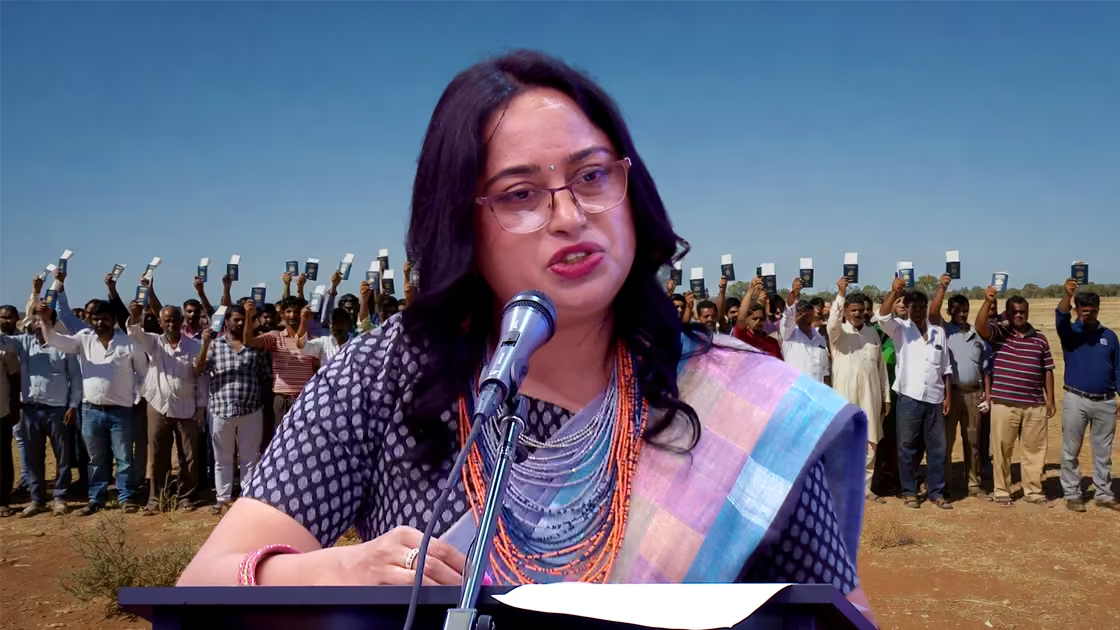
After the March for Australia flyers targeted Indians, one proud Aussie of Indian heritage steps up and sets the record straight.  Shalini Bhasin presents "Migrant's Journey to Australia".

So how good is Indian migration to Australia?

After the March for Australia flyers targeted Indians, one proud Aussie of Indian heritage steps up and sets the record straight.  Shalini Bhasin presents "Migrant's Journey to Australia".


TRANSCRIPT: 

(This transcript is derived from an automated process.  The video recording is authoritative.)  

Shalini Bhasin:

Okay, good evening everyone. I understand that the past two weeks post August 31st NT mass migration rally has been particularly challenging for Australians of the Indian heritage. The national flyer which singled out the Indian community manifested into a full blown out parliamentary debate as well as in the community circles. It is to be noted that I personally had flagged this risk to the organisers and my repeated request to withdraw the flyer was overlooked.

Those fears have come true now as derogatory remarks are on the rise in the school grounds, university campuses and supermarkets with few ill-informed and misguided locals who due to the false propaganda under under wrong impression that Indian immigrants are sole responsible for the social and economic problems that we all face as a nation in 2025. The innocent everyday million plus residents of the Indian heritage suddenly felt unsafe in their own country.

List to mention both sides of the politics tried their best to fuel to fire with an aim of winning vote banks. It was just last year that Australia recognised October as a Hindu heritage month. It was just last year that we all shared our national beauty Christian right for wearing Sauri to the misword pageant in 2024. It's been a time for introspection as an active political citizen and also personally as an Australian Hindu of Indian heritage. I firmly believe that challenging times are also the time for growth and learning. My presentation today is to surface the truth in the most unbiased way possible.
Migrant's journey to Australia, an Indian heritage trail. My name is Shalini and I'm an Australian citizen and skilled migrant living here for 20 years. I am a proud Australian. The idea today is to get an overall perspective on immigration, which is a core problem and find a solution together as a community and also policymakers. My background is intergovernment audit and risk advisory. I do go in depth into issues from a very analytical and policy aspect. So today's presentation's going to be a little bit deeper.

So why do people migrate? What is the reason behind current migration? It's important for us to understand the problem deeply. In order for the migration to happen, there's always a push factor and there's always a pull factor. The push factor generally is war and conflict in the home country, lack of economic opportunities, corrupt government administrative machinery, or for some personal reasons that people may move, such as gender bias, family outcast, health reasons, faith intolerance, danger to life.
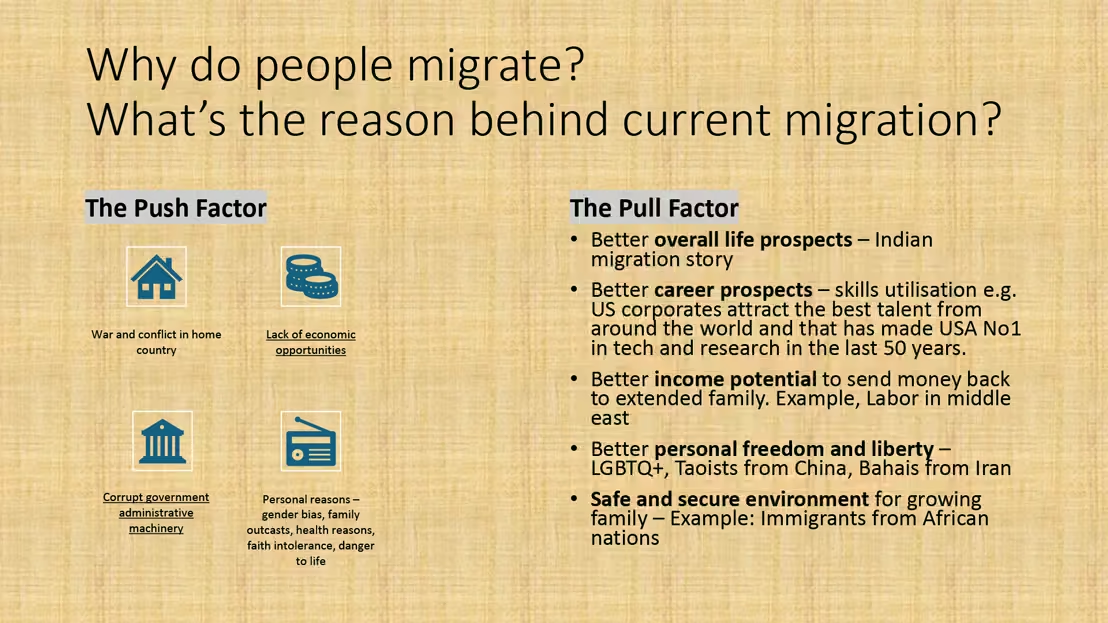
So one or more of those factors are generally there for a psychological decision to move from one country to another country. There's always a pull factor. In the case of the Western world, it has been better overall life prospects, which has been majority Indian migration story. Better career prospects, skill utilisation. Example, the US corporate attracts the best talent in the world and has become number one in tech and research in the last 50 years because of that. Better income potential to send money back to extended families. Example, labour in the Middle East, better personal freedom and liberty, such as in the case of the LGBTQ communities or the towers from China's or Baha'is from Iran who moved to Western countries. Safe and secure environment for growing families. For example, immigrants from the African nations.
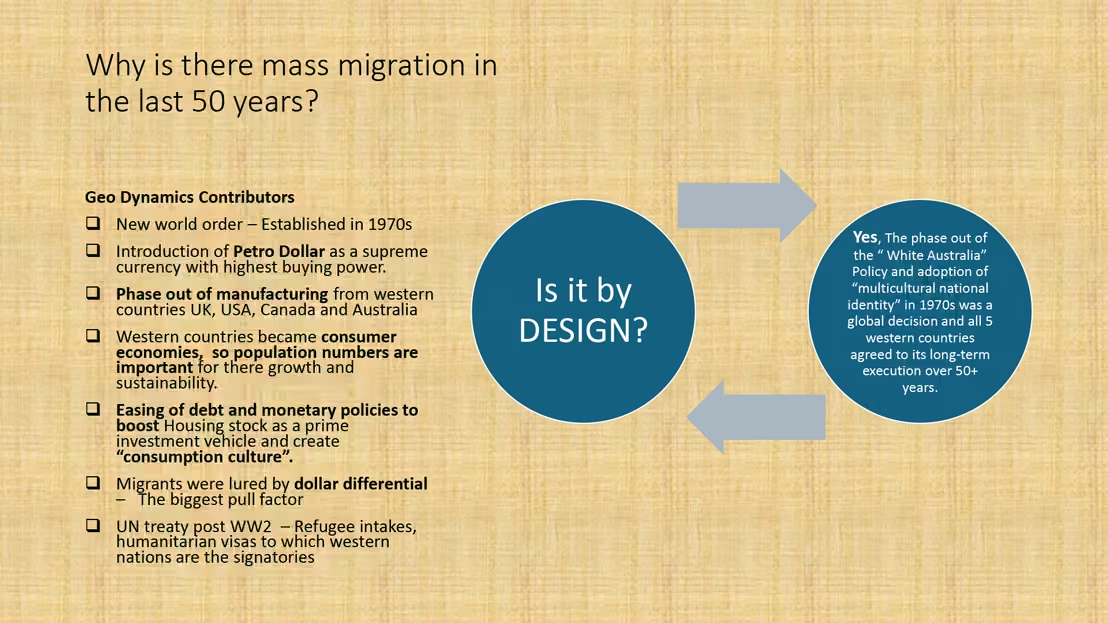
So why is there mass migration in the last 50 years? That was the question that was striking me. So I dig deeper to analyse it. Is it by design or are there any geodynamics contributors? It is important to remember that the new word order was established in 1970s. It was the introduction of the petrodollar as a supreme currency with highest buying power. It was also the period where governments decided in the Western country to phase out the manufacturing. The Western countries became consumer economies, so population numbers are important. At the same time, there was easing of the debt and the monetary policies to boost housing stock as a prime investment vehicle and create consumption culture in all the Western countries. Migrants were lowed by the dollar differential, much like the gold rush, the biggest pull factor of the best in countries. And besides that, of course, post World War II, UN treaty, and there was an obligation to take refugees and humanitarian visas.

So is it by design? Yes.

The face out of the white Australia policy and adoption of multicultural national identity. In 1970s was a global decision and all five Western countries agreed to its long-term execution over 50 plus years.
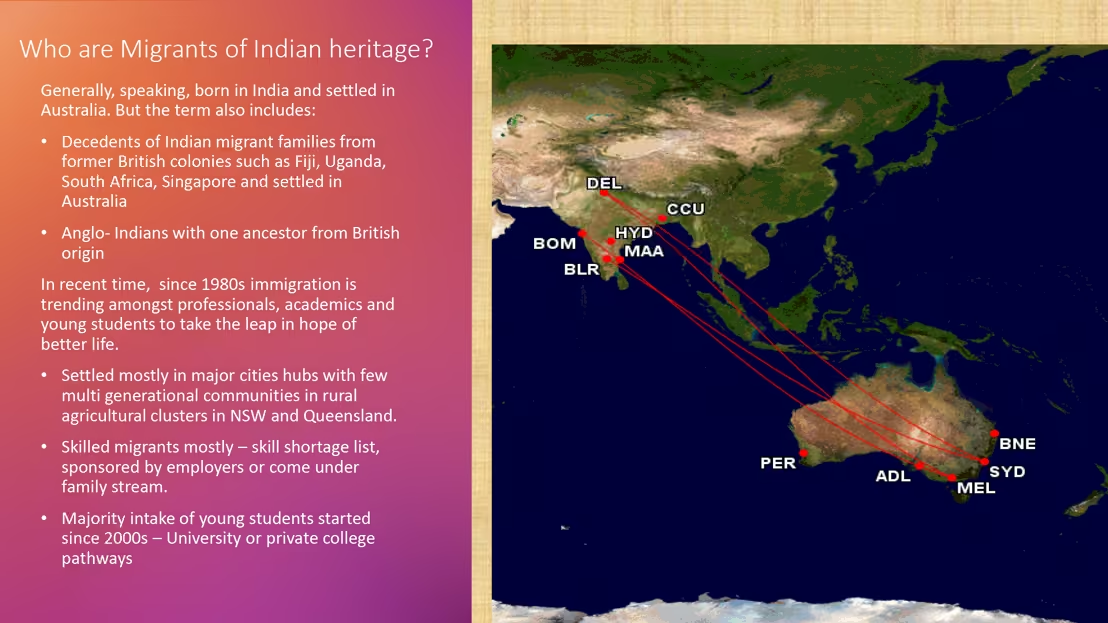
So who are the migrants of the Indian heritage that we call? Generally speaking, born in India and settled in Australia. But the term Indian heritage also includes descendants of the Indian migrant families from former British colonies, such as Fiji, Uganda, South Africa, Singapore, and settled in Australia. It also includes Anglo Indians with one ancestor from the British ancestry. In recent times since 1980s, immigration is trending amongst professionals, academics, and young students to take the leap in hope of a better life. They're mostly settled in major city hubs with few multi-generational communities in rural agricultural clusters in New South Wales and Queensland. They're mostly skilled migrants and they're employed or sponsored. Majority intake of the young students started since 2000s with the university of private college pathways.
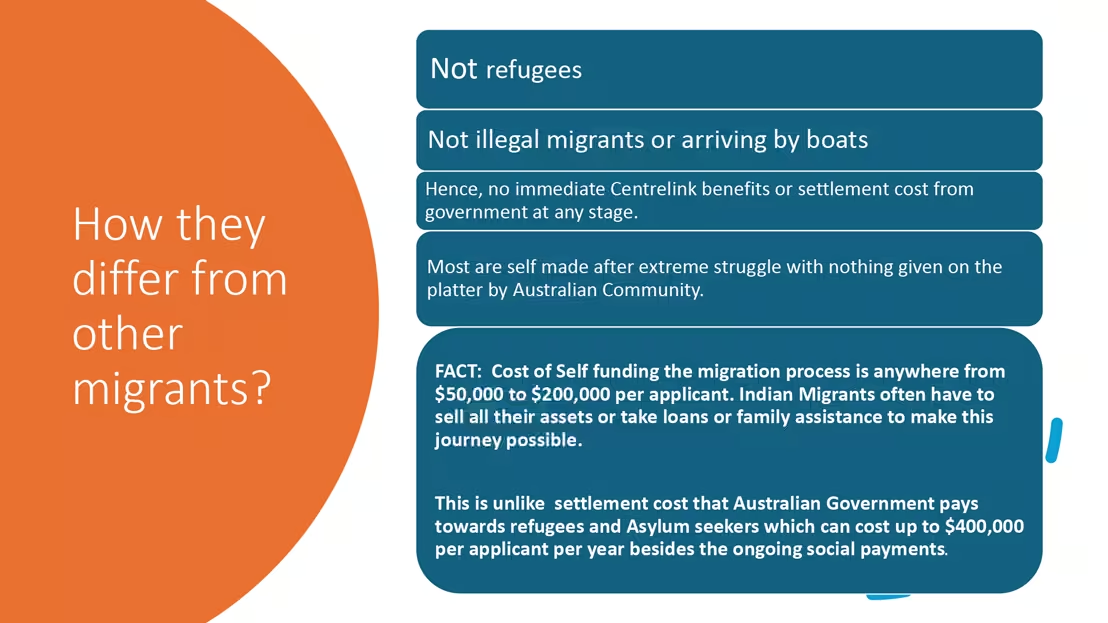
So how are they different from other migrants? It is important to understand this subset. It is important to note that they are not refugees. They're not illegal migrants or arriving by both. Hence, no immediate centering benefits or settlement cost from government at any stage. Most are self-made after extreme struggle with nothing given on the platter by the Australian community. The fact of the matter is the cost of self-funding the migration process is anywhere from $50,000 to $200,000 per applicant. Indian migrants often have to settle all their assets or take loans or family assistance to make this journey possible. This is unlike the settlement that Australian government pays towards refugees and asylum seekers, which can cost up to 400,000 per applicant pourier besides the ongoing social payments. And that is the difference of the people of the Indian migrants versus the refugees.
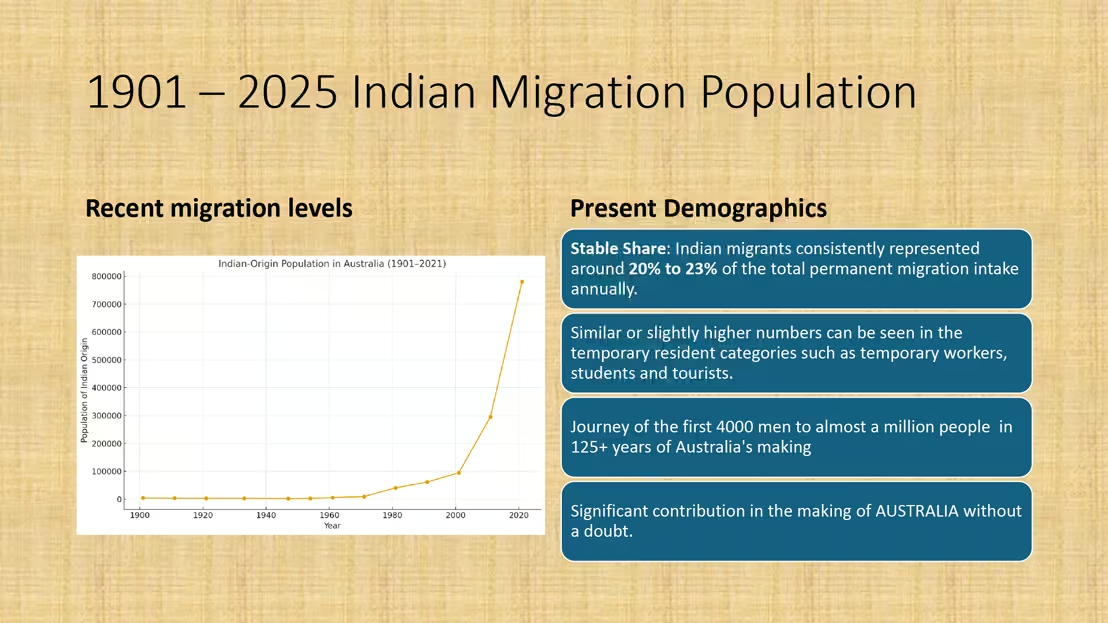
Well, if you look at the graph, 1901 to 2025, Indian migration population has increased substantially. Indian migration consistently represent around 20 to 23% of the total permanent migration intake annually. Similarly or slightly higher number can be seen in the case of temporary resident categories such as the temporary workers, students, and tourists. The journey of the 4,000 men to almost a million people in 125 years of Australia's making. It is a significant contribution in the making of Australia without a doubt.
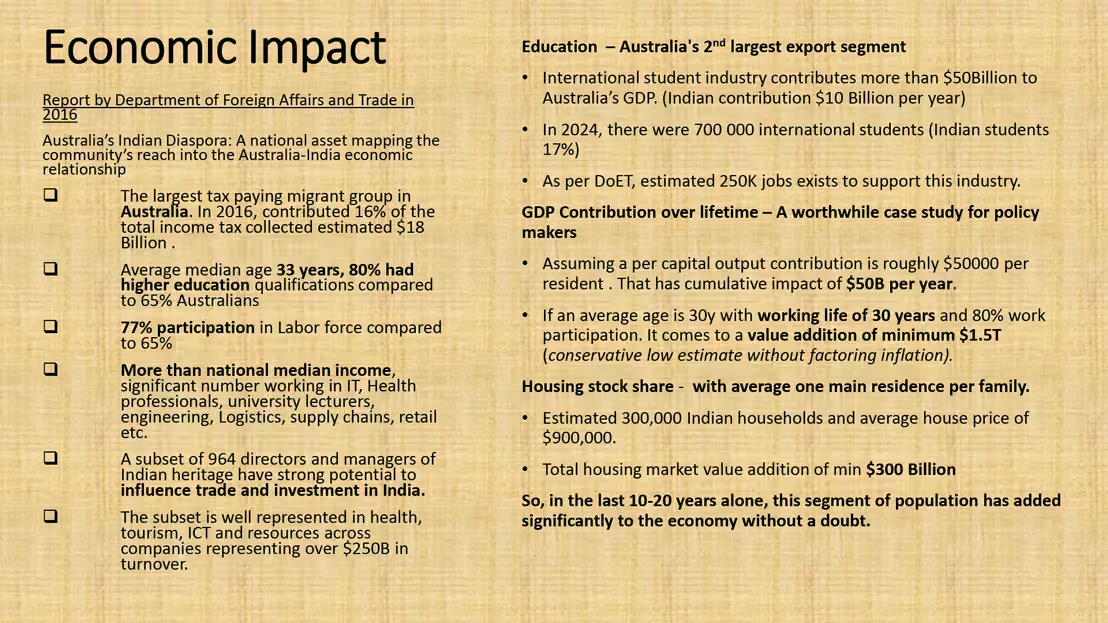
So what has been the economic impact of all this? There was an interesting report by the Department of Foreign Affairs and Trade in 2016. It was called Australia's Indian Diaspora, a national asset mapping the community's reach into the Australian-Indian economic relationship. I repeat, it calls it a national asset. The key highlights of the report was the largest tax-paying migrant group in Australia in 2026.

It contributed 16% of the total tax collected, estimated at $18 billion a year. Average medium age of an Indian is 33 years in this country. 80% have higher education, higher qualification education compared to 65% of average Australians. 77% participation in the labour force compared to 65%. More than national medium income, significant numbers working in IT, health professionals, university, lectures, engineers, logistics, supply chains, and retail, et cetera. Just a subset of 964 directors and managers of the Indian heritage have strong potential to influence trade and investment in India, which currently sits at $65 billion to the Australian economy and expected to grow to $100 billion. The subset is also represented in sectors, which currently have 250 billion in turnover.

It is also important to note, as we hear a lot about international students whenever we label immigrants. Education. Please note, education is Australia's second largest export segment. International student industry contributes more than $50 billion to the Australian GDP, and the Indian student alone contribution is $10 billion per year. In 2024, there are 700,000 international students, and Indian students constituted 17%. It's how you look at it. Department of Education and Training estimated 250,000 jobs exist to support this industry. Do you want to shut down the international students' industry? Yes. Wow. Great. Well, the GDP contribution over lifetime, a worthwhile case study of policymakers. Well, it is an interesting ... I made certain assertions to see how it flows in, but it is something which somebody, if they want to do a case study. Just assuming a per capital output contribution is roughly 50,000 per resident that would accumulate to $50 billion if it makes sense.

Well, anyway, it adds up to trillions of dollars when you look into the GDP contribution of migrants of that number over their lifetime. Similarly, their housing stock share with estimated 300,000 families comes to a housing market share of $300 billion, and that's in addition to Australia's economy.
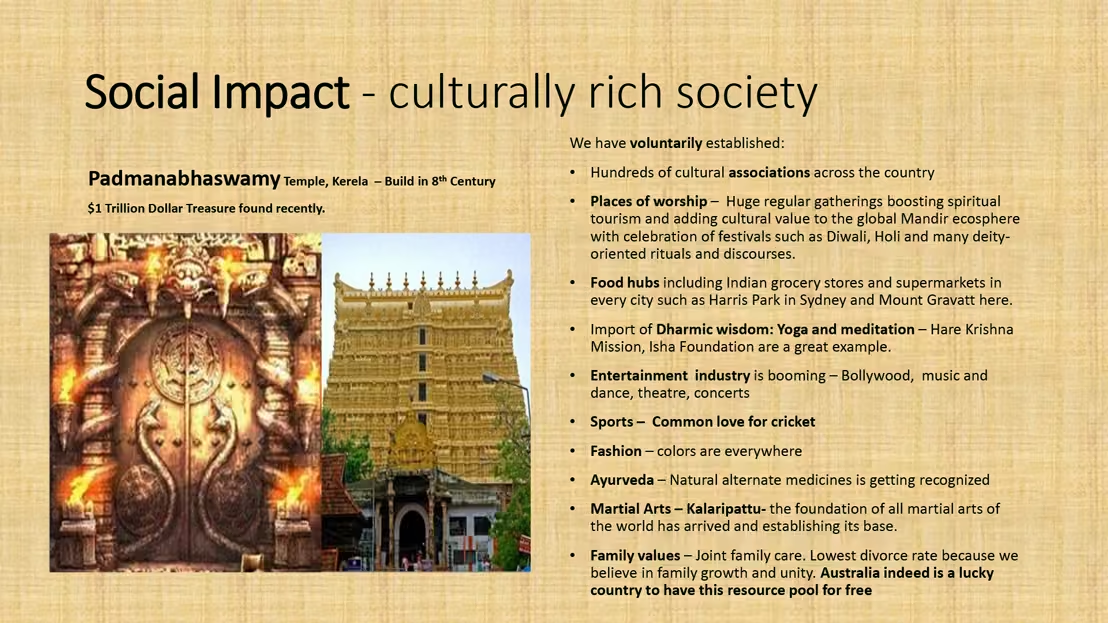
There is, of course, the social impact, and it is important for a migrant category or migrants to see whether their impact is positive or negative on the society. It is important to note that we have voluntarily established hundreds of cultural associations across the country. There are places of worship, food hubs, import of the Dharmic wisdom of yoga and meditation that helps everybody. Entertainment industry, it is booming and it adds to the Australian economy. Sports, which is a common culture for cricket, fashion, of course, adding colours everywhere. Iowa, an alternate medicine system, which is going to help everybody. Martial arts, Calorie Patoo, which is the foundation of all martial arts, is now being introduced also in Australia. And there is, of course, the family values, the joint family care and the lowest divorce rate because we believe in family growth and unity. Australia indeed is a lucky country to have a resource, all of that resource for free.

Yet we are debating if migration is good or bad. Let's look back into the history and see if we can have more clarity.
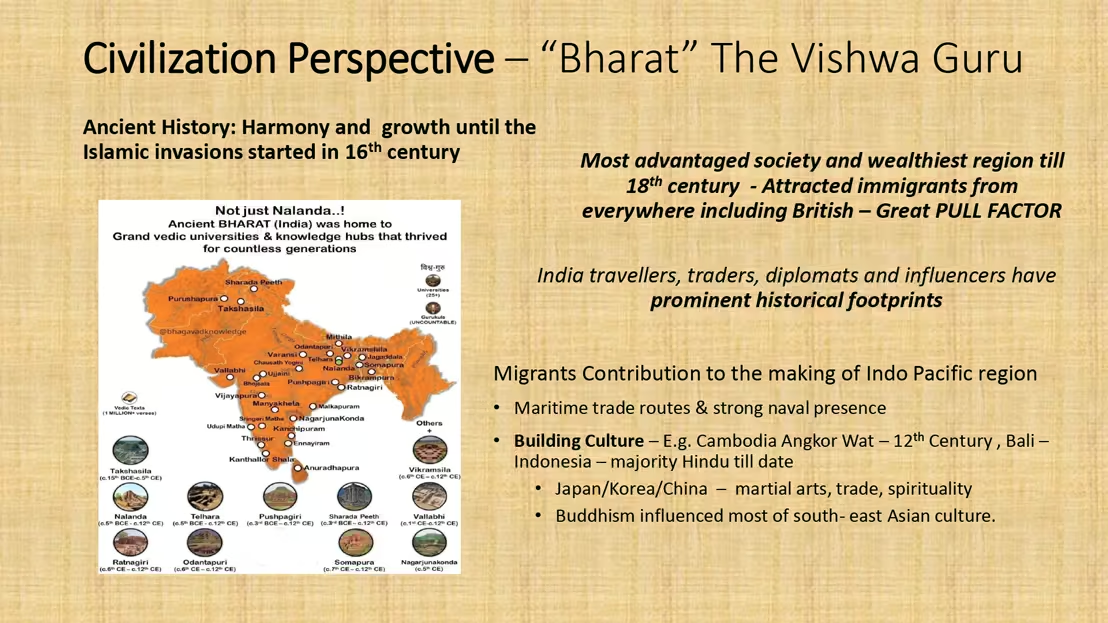
Let's have a civilizational perspective. Bharath, the wishwaguru, the word leader, a term well accepted in today's time in the international diplomatic dialogues. Most advantaged society and wealthiest region till the 18th century. It attracted immigrants from everywhere, including British. It had a great pull factor. The Indian travellers, traders, diplomats, and influencers have prominent historical footprints, and that can be seen around Southeast Asia.
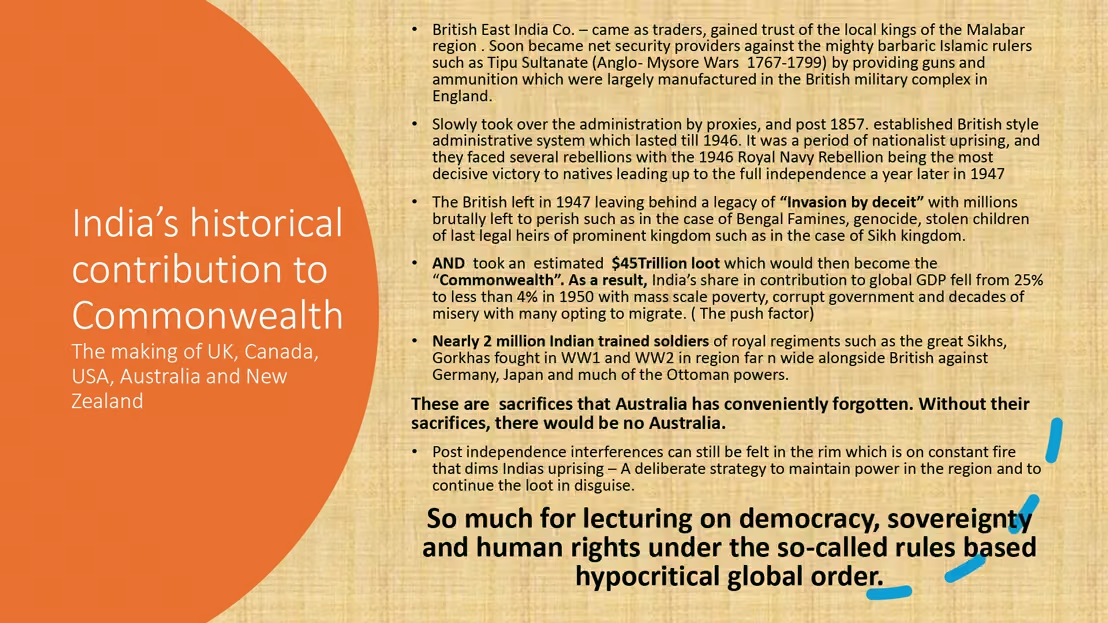
So what to say? So what do we know about the India's historical contribution to Commonwealth? The making of UK, Canada, USA, Australia, and New Zealand. And might I say, when I say the slide, it might disturb a few people, but we are referring to certain historical facts here. British East India Company came as traders. They gained trust of the local kings of the Malabar region, soon became net security providers against the mighty barbaric Islamic rulers such as the Tipu Sultanet by providing guns and eminitions, which were largely manufactured in the British military complex in England.

Slowly took over the administration by proxies and post 1857, established British style administrative systems, which lasted till 1946. It was a period of nationalistic uprising and they faced several rebellion with the 1946 Royal Navy rebellion being the most decisive victory to natives leading to the full independence in a year later in 1947. The British left in 1947, leaving behind a legacy of invasion by deceit, with millions brutally left to perish, such as in the case of Bengal feminines, genocides, stolen generation of the last legal hires of the prominent kingdoms such as in the case of Sikh Kingdom and took an estimate $45 trillion loot, which would then become the commonwealth. As a result, India's sharing the contribution to global GDP fell from 25% to less than 5%. In 1950, and mass scale poverty, Kurupt government and decades of misery with many opting to migrate, and that was the push factor.

Nearly two million Indian trained soldiers and many of you wouldn't have even ever heard of them. Nearly two million Indian trained soldiers of royal regimens, such as the great Sikhs, Gorkas, fought in World War I, and World War II in region far and wide, alongside British, against Germany, Japan, and much of the Ottoman empire. These are the sacrifices that Australia has conveniently forgotten without their sacrifices, there would be no Australia. Post-independence interferences can still be felt in the rim, which is of constant fire that dims the India's uprising, a deliberate strategy to maintain power in the region and to continue the loot in disguise.
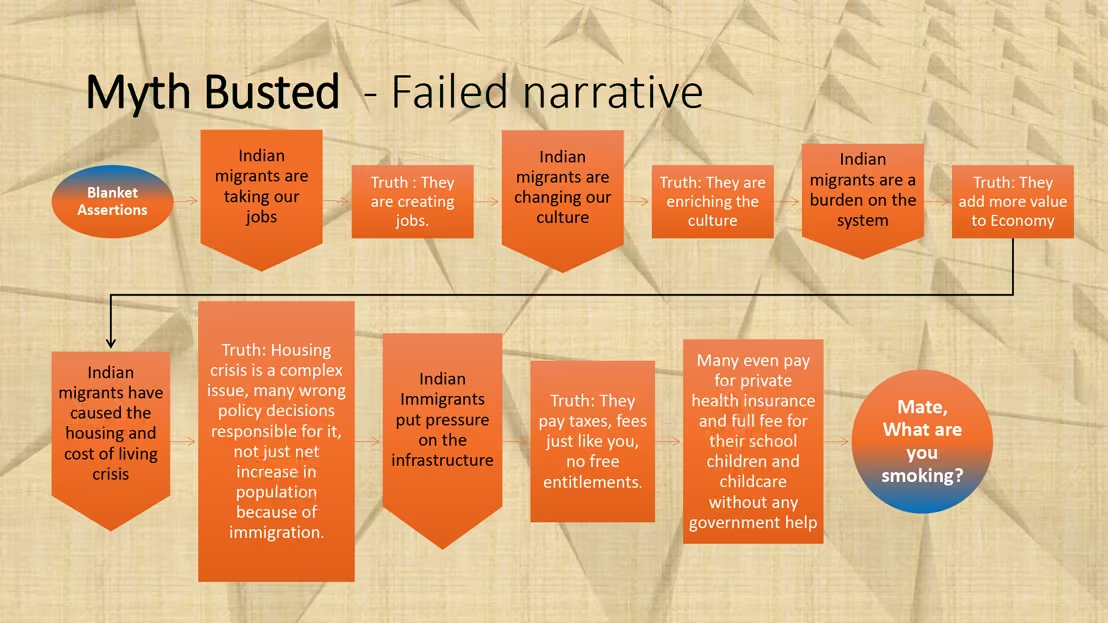
It is history and it is a difficult history that we live with, but anyway, we have decided to make Australia a home and our aim is to contribute to the place we live in. However, I would like an opportunity after doing an unbiased analysis, looking into all the facts and figures, looking at it from the economic perspective as well as social perspective, and like to bust some of the myths that have been created in the last two weeks, especially in Australia. There were certain blanket assertions which were made. Indian migrants are taking a jobs. Truth, they are creating jobs. Indian migrants are changing the culture. Truth, they're enriching the culture. Indian migrants are a burden on the system. Truth, they add more value to the economy. Indian migrants cause the housing and cost of living crisis. Truth. Housing crisis is a complex issue. Many wrong policy decisions responsible for it, not just net increase in population because of immigration.

Indian migrants put pressure on the infrastructure. Truth. They pay taxes. Remember, the larger segment? They pay taxes, fees, just like you. No free entitlements. Many even pay for private health insurance and full fee for the school children and childcare without any government help.
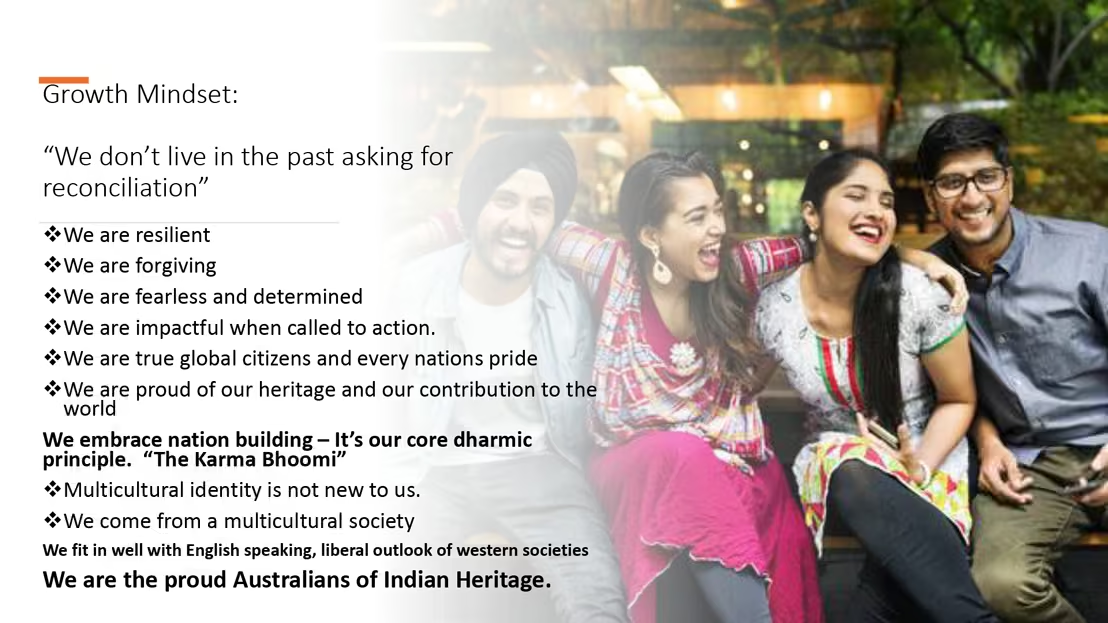
It's important to know that Indians generally have a growth mindset. You need to understand the community before you make an opinion of them. They generally have a growth mindset. We don't live in the past asking for reconciliations. We don't want to. We are resilient. We are forgiving. We are fearless and determined. We are impactful when called to action. We are the true global citizens, every nation's pride. We are proud of our heritage and our contribution to the world. We embrace nation building. It's a core harmic principle, the karma booming. Multicultural identity is nothing new to us. We come from a multicultural society. We fit in well with an English speaking liberal outlook of Western societies. We are the proud Australians of Indian heritage. Please do not see us differently.
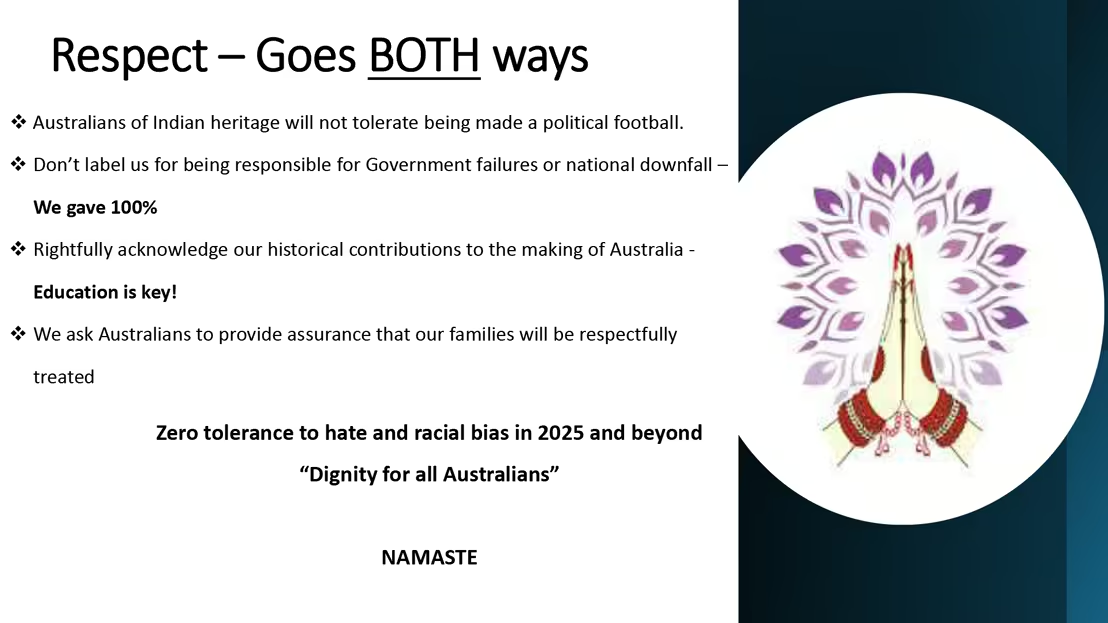
All we ask is a respect, and the respect goes two ways. Australians of Indian heritage will not tolerate being a political football as it has happened in the last two weeks and many times before. Don't label us for being responsible for government failures or national downfall. We gave our hundred person to this country. Rightfully acknowledge our historical contributions to the making of Australia. Education is key. At least acknowledge the two million who gave their life. We ask Australians to provide assurance that our families will be respectfully treated, and we want zero tolerance to hate and racial bias in 2025 and beyond. I believe we all can agree to one thing, and that is dignity for all Australians.


So how good is Indian migration to Australia?
Watch the video


TRANSCRIPT: 

(This transcript is derived from an automated process.  The video recording is authoritative.)  

Shalini Bhasin:

Okay, good evening everyone. I understand that the past two weeks post August 31st NT mass migration rally has been particularly challenging for Australians of the Indian heritage. The national flyer which singled out the Indian community manifested into a full blown out parliamentary debate as well as in the community circles. It is to be noted that I personally had flagged this risk to the organisers and my repeated request to withdraw the flyer was overlooked.

Those fears have come true now as derogatory remarks are on the rise in the school grounds, university campuses and supermarkets with few ill-informed and misguided locals who due to the false propaganda under under wrong impression that Indian immigrants are sole responsible for the social and economic problems that we all face as a nation in 2025. The innocent everyday million plus residents of the Indian heritage suddenly felt unsafe in their own country.

List to mention both sides of the politics tried their best to fuel to fire with an aim of winning vote banks. It was just last year that Australia recognised October as a Hindu heritage month. It was just last year that we all shared our national beauty Christian right for wearing Sauri to the misword pageant in 2024. It's been a time for introspection as an active political citizen and also personally as an Australian Hindu of Indian heritage. I firmly believe that challenging times are also the time for growth and learning. My presentation today is to surface the truth in the most unbiased way possible.

Migrant's journey to Australia, an Indian heritage trail. My name is Shalini and I'm an Australian citizen and skilled migrant living here for 20 years. I am a proud Australian. The idea today is to get an overall perspective on immigration, which is a core problem and find a solution together as a community and also policymakers. My background is intergovernment audit and risk advisory. I do go in depth into issues from a very analytical and policy aspect. So today's presentation's going to be a little bit deeper.

So why do people migrate? What is the reason behind current migration? It's important for us to understand the problem deeply. In order for the migration to happen, there's always a push factor and there's always a pull factor. The push factor generally is war and conflict in the home country, lack of economic opportunities, corrupt government administrative machinery, or for some personal reasons that people may move, such as gender bias, family outcast, health reasons, faith intolerance, danger to life.

So one or more of those factors are generally there for a psychological decision to move from one country to another country. There's always a pull factor. In the case of the Western world, it has been better overall life prospects, which has been majority Indian migration story. Better career prospects, skill utilisation. Example, the US corporate attracts the best talent in the world and has become number one in tech and research in the last 50 years because of that. Better income potential to send money back to extended families. Example, labour in the Middle East, better personal freedom and liberty, such as in the case of the LGBTQ communities or the towers from China's or Baha'is from Iran who moved to Western countries. Safe and secure environment for growing families. For example, immigrants from the African nations.

So why is there mass migration in the last 50 years? That was the question that was striking me. So I dig deeper to analyse it. Is it by design or are there any geodynamics contributors? It is important to remember that the new word order was established in 1970s. It was the introduction of the petrodollar as a supreme currency with highest buying power. It was also the period where governments decided in the Western country to phase out the manufacturing. The Western countries became consumer economies, so population numbers are important. At the same time, there was easing of the debt and the monetary policies to boost housing stock as a prime investment vehicle and create consumption culture in all the Western countries. Migrants were lowed by the dollar differential, much like the gold rush, the biggest pull factor of the best in countries. And besides that, of course, post World War II, UN treaty, and there was an obligation to take refugees and humanitarian visas.

So is it by design? Yes.

The face out of the white Australia policy and adoption of multicultural national identity. In 1970s was a global decision and all five Western countries agreed to its long-term execution over 50 plus years.

So who are the migrants of the Indian heritage that we call? Generally speaking, born in India and settled in Australia. But the term Indian heritage also includes descendants of the Indian migrant families from former British colonies, such as Fiji, Uganda, South Africa, Singapore, and settled in Australia. It also includes Anglo Indians with one ancestor from the British ancestry. In recent times since 1980s, immigration is trending amongst professionals, academics, and young students to take the leap in hope of a better life. They're mostly settled in major city hubs with few multi-generational communities in rural agricultural clusters in New South Wales and Queensland. They're mostly skilled migrants and they're employed or sponsored. Majority intake of the young students started since 2000s with the university of private college pathways.

So how are they different from other migrants? It is important to understand this subset. It is important to note that they are not refugees. They're not illegal migrants or arriving by both. Hence, no immediate centering benefits or settlement cost from government at any stage. Most are self-made after extreme struggle with nothing given on the platter by the Australian community. The fact of the matter is the cost of self-funding the migration process is anywhere from $50,000 to $200,000 per applicant. Indian migrants often have to settle all their assets or take loans or family assistance to make this journey possible. This is unlike the settlement that Australian government pays towards refugees and asylum seekers, which can cost up to 400,000 per applicant pourier besides the ongoing social payments. And that is the difference of the people of the Indian migrants versus the refugees.

Well, if you look at the graph, 1901 to 2025, Indian migration population has increased substantially. Indian migration consistently represent around 20 to 23% of the total permanent migration intake annually. Similarly or slightly higher number can be seen in the case of temporary resident categories such as the temporary workers, students, and tourists. The journey of the 4,000 men to almost a million people in 125 years of Australia's making. It is a significant contribution in the making of Australia without a doubt.

So what has been the economic impact of all this? There was an interesting report by the Department of Foreign Affairs and Trade in 2016. It was called Australia's Indian Diaspora, a national asset mapping the community's reach into the Australian-Indian economic relationship. I repeat, it calls it a national asset. The key highlights of the report was the largest tax-paying migrant group in Australia in 2026.

It contributed 16% of the total tax collected, estimated at $18 billion a year. Average medium age of an Indian is 33 years in this country. 80% have higher education, higher qualification education compared to 65% of average Australians. 77% participation in the labour force compared to 65%. More than national medium income, significant numbers working in IT, health professionals, university, lectures, engineers, logistics, supply chains, and retail, et cetera. Just a subset of 964 directors and managers of the Indian heritage have strong potential to influence trade and investment in India, which currently sits at $65 billion to the Australian economy and expected to grow to $100 billion. The subset is also represented in sectors, which currently have 250 billion in turnover.

It is also important to note, as we hear a lot about international students whenever we label immigrants. Education. Please note, education is Australia's second largest export segment. International student industry contributes more than $50 billion to the Australian GDP, and the Indian student alone contribution is $10 billion per year. In 2024, there are 700,000 international students, and Indian students constituted 17%. It's how you look at it. Department of Education and Training estimated 250,000 jobs exist to support this industry. Do you want to shut down the international students' industry? Yes. Wow. Great. Well, the GDP contribution over lifetime, a worthwhile case study of policymakers. Well, it is an interesting ... I made certain assertions to see how it flows in, but it is something which somebody, if they want to do a case study. Just assuming a per capital output contribution is roughly 50,000 per resident that would accumulate to $50 billion if it makes sense.

Well, anyway, it adds up to trillions of dollars when you look into the GDP contribution of migrants of that number over their lifetime. Similarly, their housing stock share with estimated 300,000 families comes to a housing market share of $300 billion, and that's in addition to Australia's economy.

There is, of course, the social impact, and it is important for a migrant category or migrants to see whether their impact is positive or negative on the society. It is important to note that we have voluntarily established hundreds of cultural associations across the country. There are places of worship, food hubs, import of the Dharmic wisdom of yoga and meditation that helps everybody. Entertainment industry, it is booming and it adds to the Australian economy. Sports, which is a common culture for cricket, fashion, of course, adding colours everywhere. Iowa, an alternate medicine system, which is going to help everybody. Martial arts, Calorie Patoo, which is the foundation of all martial arts, is now being introduced also in Australia. And there is, of course, the family values, the joint family care and the lowest divorce rate because we believe in family growth and unity. Australia indeed is a lucky country to have a resource, all of that resource for free.

Yet we are debating if migration is good or bad. Let's look back into the history and see if we can have more clarity.

Let's have a civilizational perspective. Bharath, the wishwaguru, the word leader, a term well accepted in today's time in the international diplomatic dialogues. Most advantaged society and wealthiest region till the 18th century. It attracted immigrants from everywhere, including British. It had a great pull factor. The Indian travellers, traders, diplomats, and influencers have prominent historical footprints, and that can be seen around Southeast Asia.

So what to say? So what do we know about the India's historical contribution to Commonwealth? The making of UK, Canada, USA, Australia, and New Zealand. And might I say, when I say the slide, it might disturb a few people, but we are referring to certain historical facts here. British East India Company came as traders. They gained trust of the local kings of the Malabar region, soon became net security providers against the mighty barbaric Islamic rulers such as the Tipu Sultanet by providing guns and eminitions, which were largely manufactured in the British military complex in England.

Slowly took over the administration by proxies and post 1857, established British style administrative systems, which lasted till 1946. It was a period of nationalistic uprising and they faced several rebellion with the 1946 Royal Navy rebellion being the most decisive victory to natives leading to the full independence in a year later in 1947. The British left in 1947, leaving behind a legacy of invasion by deceit, with millions brutally left to perish, such as in the case of Bengal feminines, genocides, stolen generation of the last legal hires of the prominent kingdoms such as in the case of Sikh Kingdom and took an estimate $45 trillion loot, which would then become the commonwealth. As a result, India's sharing the contribution to global GDP fell from 25% to less than 5%. In 1950, and mass scale poverty, Kurupt government and decades of misery with many opting to migrate, and that was the push factor.

Nearly two million Indian trained soldiers and many of you wouldn't have even ever heard of them. Nearly two million Indian trained soldiers of royal regimens, such as the great Sikhs, Gorkas, fought in World War I, and World War II in region far and wide, alongside British, against Germany, Japan, and much of the Ottoman empire. These are the sacrifices that Australia has conveniently forgotten without their sacrifices, there would be no Australia. Post-independence interferences can still be felt in the rim, which is of constant fire that dims the India's uprising, a deliberate strategy to maintain power in the region and to continue the loot in disguise.

It is history and it is a difficult history that we live with, but anyway, we have decided to make Australia a home and our aim is to contribute to the place we live in. However, I would like an opportunity after doing an unbiased analysis, looking into all the facts and figures, looking at it from the economic perspective as well as social perspective, and like to bust some of the myths that have been created in the last two weeks, especially in Australia. There were certain blanket assertions which were made. Indian migrants are taking a jobs. Truth, they are creating jobs. Indian migrants are changing the culture. Truth, they're enriching the culture. Indian migrants are a burden on the system. Truth, they add more value to the economy. Indian migrants cause the housing and cost of living crisis. Truth. Housing crisis is a complex issue. Many wrong policy decisions responsible for it, not just net increase in population because of immigration.

Indian migrants put pressure on the infrastructure. Truth. They pay taxes. Remember, the larger segment? They pay taxes, fees, just like you. No free entitlements. Many even pay for private health insurance and full fee for the school children and childcare without any government help.

It's important to know that Indians generally have a growth mindset. You need to understand the community before you make an opinion of them. They generally have a growth mindset. We don't live in the past asking for reconciliations. We don't want to. We are resilient. We are forgiving. We are fearless and determined. We are impactful when called to action. We are the true global citizens, every nation's pride. We are proud of our heritage and our contribution to the world. We embrace nation building. It's a core harmic principle, the karma booming. Multicultural identity is nothing new to us. We come from a multicultural society. We fit in well with an English speaking liberal outlook of Western societies. We are the proud Australians of Indian heritage. Please do not see us differently.

All we ask is a respect, and the respect goes two ways. Australians of Indian heritage will not tolerate being a political football as it has happened in the last two weeks and many times before. Don't label us for being responsible for government failures or national downfall. We gave our hundred person to this country. Rightfully acknowledge our historical contributions to the making of Australia. Education is key. At least acknowledge the two million who gave their life. We ask Australians to provide assurance that our families will be respectfully treated, and we want zero tolerance to hate and racial bias in 2025 and beyond. I believe we all can agree to one thing, and that is dignity for all Australians.