
They Want You Silent. The Professor Says Break the Law.

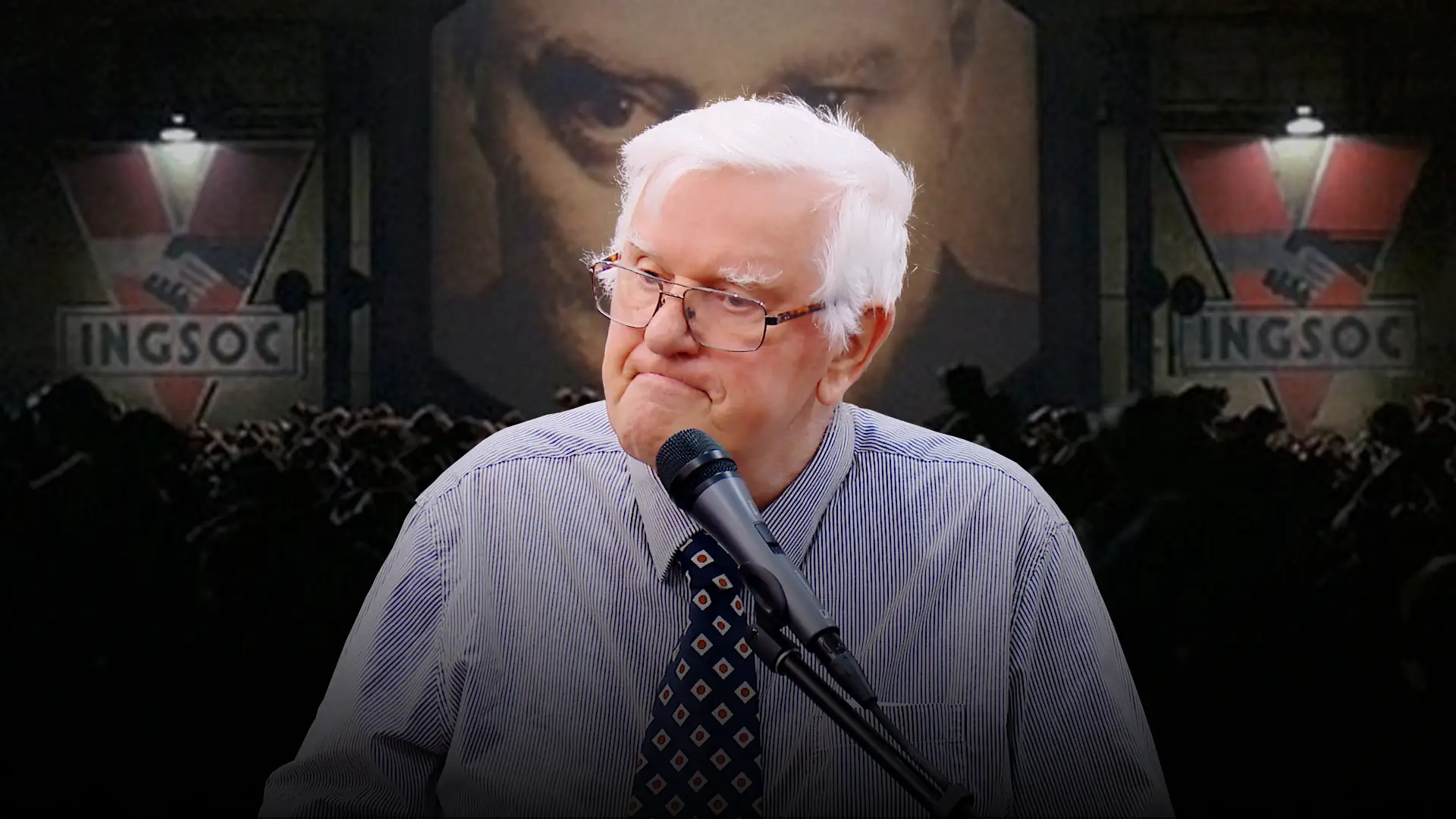
Hate-speech laws don’t kill hate—they drive it underground to fester and explode later. Real democracy demands a marketplace of ideas where even offensive speech is met with better speech, not handcuffs.
They Want You Silent. The Professor Says Break the Law.
Hate-speech laws don’t kill hate—they drive it underground to fester and explode later. Real democracy demands a marketplace of ideas where even offensive speech is met with better speech, not handcuffs.

TRANSCRIPT: 

(This transcript is derived from an automated process.  The video recording is authoritative.) 

Prof. Gabriël Moens:
Well, good evening to all of you. This is a very unusual situation for me, namely to stand behind a lectern. Normally, I would like to walk around with a lapel microphone. That is when I really enjoy teaching my students. So unfortunately, you will have to suffer me tonight standing behind this lectern.

And I should like to begin by thanking a number of people. I would like to thank Mrs. Burbidge for organising this event. Her events are always organised very well indeed. I should also like to thank the first two speakers for updating us. And of course, I would have to thank Professor Augusto Zimmerman. As you know, he said some very nice things about me and I couldn't possibly disagree with him. Yeah. That's obvious. He obviously has a very good taste indeed.

I should also like to mention that Mrs. Burbidge said that everyone will be able to benefit from reading of this book. Yes, you will, because it is actually written in English.

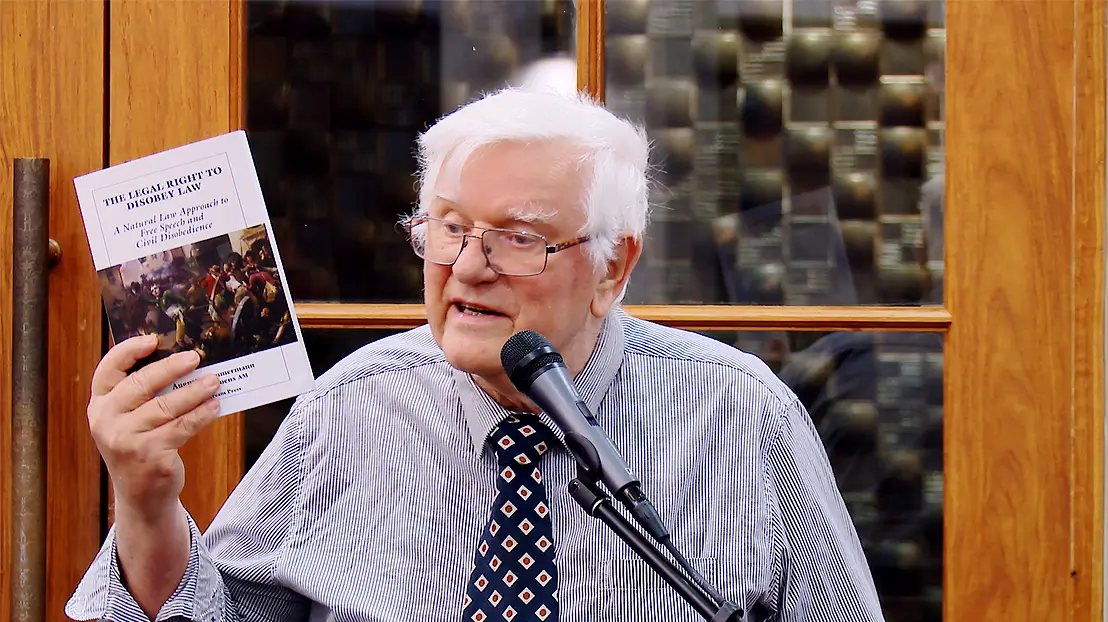
Now, this book, The Legal Right to Disobey Law, is about free speech and civil disobedience. So let me say a few things about free speech first. Both Professor Zimmerman and I have been free speech warriors as long as we have been in Australia. We believe that free speech is absolutely essential if we want to maintain the Australian democracy. We have to be able to participate in social, economic, and financial debates to make this country much better than it is today. That is important. So free speech is incredibly important, yet we know that nowadays free speech is under threat, not just in Australia, but globally.
We know that during the last couple of years, there have been many laws adopted by the Australian parliament that threaten the survival of free speech in this country. They call it hate speech legislation. And the hate speech legislation applies a subjective test. Conduct or speech is going to be hate speech if it is deemed to be hate speech by the recipient of the message. That is what hate speech is about.

And I would like to tell you that I am very much against the hate speech legislation that we have in Australia. And I'll tell you the reason. Hate speech legislation inevitably only ever deals with the symptoms of a problem, but never with the cause of the problem. Mind you, hate speech legislation is going to be very effective because you will not want to go to jail by violating the law. You will not want to pay a huge fine by violating the law.

But even though the law will be effective, the law will never be able to eliminate hate from our society because the philosophy, the ideology, the sentiments upon which hate is based will simply go underground where it will fester and infect and it will resurface in the future at an opportune time.

My view is that what we need in this country is a marketplace of free speech. If somebody makes an unwise comment or a stupid comment or even an offensive comment, then somebody else will use their free speech to excoriate those statements, to criticise the statements, and out of this process will come to truth.

It's very important to realise that free speech actually involves the right of people to offend others. And this is a statement that was made many times by leading scholars around the world, including of course Salman Rusdi, the English novelist.

Because if we can't offend other people, if we can't make offensive remarks about other people, we are inevitably going to compromise our ability to assess the merits and demerits of other people in our society.

So that is what I wanted to tell you about free speech very briefly.

Now coming to civil disobedience, civil disobedience is the intentional or the deliberate violation of a law which has been legally adopted, or it is the violation of an order which has been legally addressed to a person or a group of people. And they violate the law because the law is deemed to be incompatible with higher principles, moral principles, say natural rights, or perhaps God's commands as revealed in the scriptures.

Now, one thing I would like to tell you now, neither Professor Zimmerman or I say that free speech should be absolute. No, we don't say that because in our book, we actually argue for a rational version of free speech. Free speech may well have to be restricted depending on the circumstances, depending on the place where the free speech is happening. So we talk about a rational version of free speech.

And I would like to give you an example of exactly what I mean by that. From 1991 to 2014, I was involved in the summer programme of the University of Notre Dame, that is the American University in London. And in 1991, the first year that I was involved in the programme, I asked permission to attend the lectures of one of their professors who had been a member of staff for a long, long time in the summer programme. I wanted to learn from him and I did learn from him, but I did not learn from him what I wanted to learn. And I'll tell you why.

The professor had 50 students in the class. All of them were American. And the professor in his first class said, "Look, I am not married at all and I don't want to get married. However, I live with 16 cats, a cat, and I like cats much more than people, including students." That I think is not really a very intelligent way to behave, I thought. However, what came after that was even more shocking to me. Then he said, "If you are a member of the Republican Party or if you intend to vote Republican at the next election, you will fail this subject and I will make sure you will fail this subject."

Now you must realise that the class consisted of 50 American students and therefore one can reasonably expect that about 50% might have Republican tendencies.

So I was absolutely shocked and I said to myself, "I really have to come back to class tomorrow to see how many students turn up." And indeed, the next day there were approximately 20 students in the class, presumably all the Democrats or all the people who intended to vote for the Democratic Party.

Now, why do I tell you this? I'm telling you this story because obviously the professor should not have made those egregious comments. A classroom is not the appropriate place, not the appropriate forum to make comments of this particular nature. That is why I say that free speech cannot possibly be absolute. It must necessarily be restricted by the circumstances and the place. After all, a classroom is not a political rally.

Indeed, one could say that a professor does not have the right to tell the students what to think. The job of a professor is to ensure that the students are able to think. It is about teaching them how to think. Obviously, he was not aware of that.

So there is a rational version of free speech and there is also a rational version of civil disobedience. Indeed, civil disobedience and free speech up to a certain point conceptually overlap. And this is because civil disobedience is often described as communication, the message of which is received and understood by a recipient. So the two concepts sometimes overlap.

So civil disobedience refers often to conduct that involves the communication of a message. And there is a very good example of that in the United States. In 1969, the American Supreme Court decided the case of Tinker and Des Moines. It is about school children who came to school with a black armband to protest against a war in Vietnam. And they came to school with a black armband even though there was a school policy that they should not be coming to school with a black armband.

Now, the chief justice of the United States and a few of the other justices decided that this type of conduct is an example of civil disobedience, which is actually protected by the First Amendment. Justice Fortas, for example, said, "The First Amendment to the United States, which protects freedom of speech, protects much more than the words that you find in a pamphlet. It will also protect behaviour and conduct of this particular kind."

So I'm telling you again, when I talk about civil disobedience, when Professor Zimmerman talks about civil disobedience, we talk about a particular version of civil disobedience, a rational version of civil disobedience.

It does not mean that whenever you don't like a law, you are entitled to be involved in rebellion or in dissident action. There are many laws that I dislike in this country, but of course I'm not necessarily going to rebel each time I don't like a law. If that were to be the case, I would do nothing else in my life but rebel. And there are other things to do if you want to have a productive life.

So what exactly then does it mean when I say that we are in favour of a rational type of civil disobedience? Well, as I said before, civil disobedience involves the violation of a law because the law is incompatible with higher principles, right?

But these higher principles may be incompatible with another opposing set of higher principles. And therefore, a person who wants to become a civil disobedience should balance these competing sets of higher principles with each other, seek a reconciliation of these conflicting and opposing sets of higher principles. And if you can't be involved in a balancing act, then perhaps you should not be involved in civil disobedience at all. In fact, not being involved in civil disobedience may in fact be an act of moral courage.

In addition, our version of civil disobedience requires that a civil disobedient person must also have a motive, a motive namely to make society into a better place or perhaps to seek the repeal of a law they are rebelling against. So there must be a motivation.

And if you want to change society for the better, which is why persons would be involved in civil disobedience, their civil disobedient act must be performed in public so that the public knows why they are protesting against the government and how they are protesting against the government and why it is necessary to change society.

And it also requires in that case that they would be willing to accept the penalty which will inevitably be imposed by the government or by the authorities on people who violate the law.

Indeed, being willing to accept a penalty which is imposed by the authorities means that you are not protesting against the legal system. It means that you do not want to destroy the legal system. It simply means that you hope to seek the repeal of a particular law you are rebelling against.

In addition, a civil disobedient person in our view should always consider the consequences of their action, not the consequences of the actions for themselves, but for society at large, the social, economic, financial cost, which inevitably would have to be paid by all of us.

And finally, there must be proportionality because the action that a person is involved in must be logically related to, must be cogently related to the objective a civil disobedient person wants to achieve.

Now, this book is a treasure trove as Professor Zimmerman has indicated. And of course we hope that you will read it. It is a good read as you will find out, and it will make a terrific Christmas present, not just for yourself, but also for your children and for your friends.

Now, sometimes people ask me, "Gabriel, what is, according to you, the best example of civil disobedience that you have come across in your readings?" I would always tell them, "Well, the best example that I have come across is the case of the Rosenstrauser protest, the Rosenstreet." Strauss means street.

And I would like to take you back to the last week of February 1943 in Berlin, in Germany. In the last week of February 1943, there were still about 2,000 male Jews living in Berlin. Surprising, many people don't know this. Yes, they were discriminated against in public, but otherwise they were left alone. They were not deported. They were not tortured. They were not arrested. Essentially, they were left alone until the last week of February 1943. Why? Well, because they were married to a non-Jewish woman, an Aryan woman. However, by the end of February 1943, the evil government of Germany decided they would also do away with those 2,000 male Jews.

And before I go on, I will tell you this. If you don't believe in miracles, you will believe in miracles once I finish discussing this particular example.
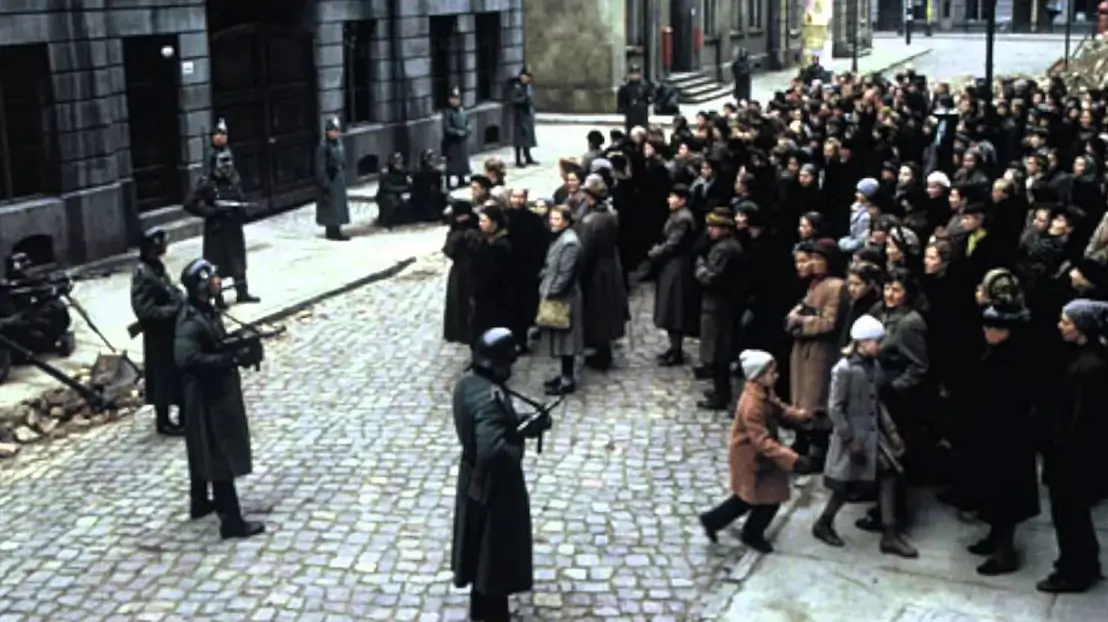
So by the end of February 1943, the male Jews were arrested and they were placed incarcerated in the Jewish clubhouse in the Rosenstrassa, which effectively became a prison.

And it was guarded by the Gestapo police. The idea was that in the coming weeks, they would progressively be sent to Auschwitz where they would be killed. However, on the first day of the incarceration, some of the women came to the clubhouse, the jail, and they screamed, "We want our husbands back. Give us back our man. Give us back our men."

Now, the second day, more women came. The third day, even more women came. And there were other women who were not married to a Jewish man who also supported the event for solidarity reasons. After about a week, there were 2,000 women screaming their head off, "Give us back our men. We want to have our men back." No, the Gestapo police did not like that very much, of course. And they addressed a legal order to the women. Disperse, retreat, or you will all be shot.

For one reason or another, the Gestapo did not kill the women. They were obviously not as vicious as the IRCG in Iran, which in January, as you know, killed tens of thousands of people. In fact, the Gestapo police sent the issue as to whether the women should be killed to the infamous Joseph Goebels, the propaganda minister. He had to make the decision as to whether the women should be killed.

And here is the first miracle. Gebels decided that the women should not be killed. Goebbels made the right decision, but for the wrong reasons, because Goebbels thought that if the women were killed, then it would no longer be possible for him to claim that everyone in Germany is 150% solidly supporting the war effort of Germany. And of course, he also believed that if the women were killed, then the allies would be able to use it to prove that there is dissent in Germany, internal descent, which would be the beginning of the end for that evil regime.

So he decided, no, the women should not be killed. And he also decided that the men should be released and reunited with their women. That's a miracle, right? So the gates opened, the men were reunited with their women.

The second miracle, in the meantime, a few days before, 26 of the men had already been sent to Auswitz where they would be killed. Those 26 men were actually returned to Berlin to be reunited with their wives. That's the second miracle.

The third miracle, they all survived the war. Those 2,000 Jewish male people survived the war.

This is, in my opinion, the best example of civil disobedience because you had a legal command which was addressed by the Gestapo to the women. The women obviously believe that the order was invalid because it was incompatible with a higher law, namely that men and women should not be separated in those circumstances.

And they were motivated by a desire to have the Gestapo withdraw that order. And perhaps if need be, they would also have been willing to sacrifice their lives, that is accept a penalty which might have been imposed by the authorities at the time upon the women. So that is, in my opinion, the best example of civil disobedience that I have come across.

Now, I would like to stop here because we have to make some time for discussion and question and answers, but I would like to say this by way of conclusion.

If you were to ask me to summarise civil disobedience in one sentence, I would say that civil disobedience is about creating or building a better world. And if you want to build a better world, you obviously have to create a better you, because in creating a better you, you will inevitably directly and indirectly be able to build a better world. That is what civil disobedience is about.

And there is an aphorism that I found on a tombstone in a Scottish church yard, but you can also find it on the web now. It is called Built a Better World. And it says, and I read it to you, "Build a better world," said God. And I answered, "How? The world is such a vast place and so complicated now, and I am small and useless. There is nothing I can do." But God, in all his wisdom, said, "Just build a better you." That is, in my opinion, what civil disobedience is about.

If I haven't convinced you that this is a necessary Christmas read, obviously I have not done a very good job. Thank you very much.
They Want You Silent. The Professor Says Break the Law.
Watch the video

TRANSCRIPT: 

(This transcript is derived from an automated process.  The video recording is authoritative.) 

Prof. Gabriël Moens:
Well, good evening to all of you. This is a very unusual situation for me, namely to stand behind a lectern. Normally, I would like to walk around with a lapel microphone. That is when I really enjoy teaching my students. So unfortunately, you will have to suffer me tonight standing behind this lectern.

And I should like to begin by thanking a number of people. I would like to thank Mrs. Burbidge for organising this event. Her events are always organised very well indeed. I should also like to thank the first two speakers for updating us. And of course, I would have to thank Professor Augusto Zimmerman. As you know, he said some very nice things about me and I couldn't possibly disagree with him. Yeah. That's obvious. He obviously has a very good taste indeed.

I should also like to mention that Mrs. Burbidge said that everyone will be able to benefit from reading of this book. Yes, you will, because it is actually written in English.

Now, this book, The Legal Right to Disobey Law, is about free speech and civil disobedience. So let me say a few things about free speech first. Both Professor Zimmerman and I have been free speech warriors as long as we have been in Australia. We believe that free speech is absolutely essential if we want to maintain the Australian democracy. We have to be able to participate in social, economic, and financial debates to make this country much better than it is today. That is important. So free speech is incredibly important, yet we know that nowadays free speech is under threat, not just in Australia, but globally.

We know that during the last couple of years, there have been many laws adopted by the Australian parliament that threaten the survival of free speech in this country. They call it hate speech legislation. And the hate speech legislation applies a subjective test. Conduct or speech is going to be hate speech if it is deemed to be hate speech by the recipient of the message. That is what hate speech is about.

And I would like to tell you that I am very much against the hate speech legislation that we have in Australia. And I'll tell you the reason. Hate speech legislation inevitably only ever deals with the symptoms of a problem, but never with the cause of the problem. Mind you, hate speech legislation is going to be very effective because you will not want to go to jail by violating the law. You will not want to pay a huge fine by violating the law.

But even though the law will be effective, the law will never be able to eliminate hate from our society because the philosophy, the ideology, the sentiments upon which hate is based will simply go underground where it will fester and infect and it will resurface in the future at an opportune time.

My view is that what we need in this country is a marketplace of free speech. If somebody makes an unwise comment or a stupid comment or even an offensive comment, then somebody else will use their free speech to excoriate those statements, to criticise the statements, and out of this process will come to truth.

It's very important to realise that free speech actually involves the right of people to offend others. And this is a statement that was made many times by leading scholars around the world, including of course Salman Rusdi, the English novelist.

Because if we can't offend other people, if we can't make offensive remarks about other people, we are inevitably going to compromise our ability to assess the merits and demerits of other people in our society.

So that is what I wanted to tell you about free speech very briefly.

Now coming to civil disobedience, civil disobedience is the intentional or the deliberate violation of a law which has been legally adopted, or it is the violation of an order which has been legally addressed to a person or a group of people. And they violate the law because the law is deemed to be incompatible with higher principles, moral principles, say natural rights, or perhaps God's commands as revealed in the scriptures.

Now, one thing I would like to tell you now, neither Professor Zimmerman or I say that free speech should be absolute. No, we don't say that because in our book, we actually argue for a rational version of free speech. Free speech may well have to be restricted depending on the circumstances, depending on the place where the free speech is happening. So we talk about a rational version of free speech.

And I would like to give you an example of exactly what I mean by that. From 1991 to 2014, I was involved in the summer programme of the University of Notre Dame, that is the American University in London. And in 1991, the first year that I was involved in the programme, I asked permission to attend the lectures of one of their professors who had been a member of staff for a long, long time in the summer programme. I wanted to learn from him and I did learn from him, but I did not learn from him what I wanted to learn. And I'll tell you why.

The professor had 50 students in the class. All of them were American. And the professor in his first class said, "Look, I am not married at all and I don't want to get married. However, I live with 16 cats, a cat, and I like cats much more than people, including students." That I think is not really a very intelligent way to behave, I thought. However, what came after that was even more shocking to me. Then he said, "If you are a member of the Republican Party or if you intend to vote Republican at the next election, you will fail this subject and I will make sure you will fail this subject."

Now you must realise that the class consisted of 50 American students and therefore one can reasonably expect that about 50% might have Republican tendencies.

So I was absolutely shocked and I said to myself, "I really have to come back to class tomorrow to see how many students turn up." And indeed, the next day there were approximately 20 students in the class, presumably all the Democrats or all the people who intended to vote for the Democratic Party.

Now, why do I tell you this? I'm telling you this story because obviously the professor should not have made those egregious comments. A classroom is not the appropriate place, not the appropriate forum to make comments of this particular nature. That is why I say that free speech cannot possibly be absolute. It must necessarily be restricted by the circumstances and the place. After all, a classroom is not a political rally.

Indeed, one could say that a professor does not have the right to tell the students what to think. The job of a professor is to ensure that the students are able to think. It is about teaching them how to think. Obviously, he was not aware of that.

So there is a rational version of free speech and there is also a rational version of civil disobedience. Indeed, civil disobedience and free speech up to a certain point conceptually overlap. And this is because civil disobedience is often described as communication, the message of which is received and understood by a recipient. So the two concepts sometimes overlap.

So civil disobedience refers often to conduct that involves the communication of a message. And there is a very good example of that in the United States. In 1969, the American Supreme Court decided the case of Tinker and Des Moines. It is about school children who came to school with a black armband to protest against a war in Vietnam. And they came to school with a black armband even though there was a school policy that they should not be coming to school with a black armband.

Now, the chief justice of the United States and a few of the other justices decided that this type of conduct is an example of civil disobedience, which is actually protected by the First Amendment. Justice Fortas, for example, said, "The First Amendment to the United States, which protects freedom of speech, protects much more than the words that you find in a pamphlet. It will also protect behaviour and conduct of this particular kind."

So I'm telling you again, when I talk about civil disobedience, when Professor Zimmerman talks about civil disobedience, we talk about a particular version of civil disobedience, a rational version of civil disobedience.

It does not mean that whenever you don't like a law, you are entitled to be involved in rebellion or in dissident action. There are many laws that I dislike in this country, but of course I'm not necessarily going to rebel each time I don't like a law. If that were to be the case, I would do nothing else in my life but rebel. And there are other things to do if you want to have a productive life.

So what exactly then does it mean when I say that we are in favour of a rational type of civil disobedience? Well, as I said before, civil disobedience involves the violation of a law because the law is incompatible with higher principles, right?

But these higher principles may be incompatible with another opposing set of higher principles. And therefore, a person who wants to become a civil disobedience should balance these competing sets of higher principles with each other, seek a reconciliation of these conflicting and opposing sets of higher principles. And if you can't be involved in a balancing act, then perhaps you should not be involved in civil disobedience at all. In fact, not being involved in civil disobedience may in fact be an act of moral courage.

In addition, our version of civil disobedience requires that a civil disobedient person must also have a motive, a motive namely to make society into a better place or perhaps to seek the repeal of a law they are rebelling against. So there must be a motivation.

And if you want to change society for the better, which is why persons would be involved in civil disobedience, their civil disobedient act must be performed in public so that the public knows why they are protesting against the government and how they are protesting against the government and why it is necessary to change society.

And it also requires in that case that they would be willing to accept the penalty which will inevitably be imposed by the government or by the authorities on people who violate the law.

Indeed, being willing to accept a penalty which is imposed by the authorities means that you are not protesting against the legal system. It means that you do not want to destroy the legal system. It simply means that you hope to seek the repeal of a particular law you are rebelling against.

In addition, a civil disobedient person in our view should always consider the consequences of their action, not the consequences of the actions for themselves, but for society at large, the social, economic, financial cost, which inevitably would have to be paid by all of us.

And finally, there must be proportionality because the action that a person is involved in must be logically related to, must be cogently related to the objective a civil disobedient person wants to achieve.

Now, this book is a treasure trove as Professor Zimmerman has indicated. And of course we hope that you will read it. It is a good read as you will find out, and it will make a terrific Christmas present, not just for yourself, but also for your children and for your friends.

Now, sometimes people ask me, "Gabriel, what is, according to you, the best example of civil disobedience that you have come across in your readings?" I would always tell them, "Well, the best example that I have come across is the case of the Rosenstrauser protest, the Rosenstreet." Strauss means street.

And I would like to take you back to the last week of February 1943 in Berlin, in Germany. In the last week of February 1943, there were still about 2,000 male Jews living in Berlin. Surprising, many people don't know this. Yes, they were discriminated against in public, but otherwise they were left alone. They were not deported. They were not tortured. They were not arrested. Essentially, they were left alone until the last week of February 1943. Why? Well, because they were married to a non-Jewish woman, an Aryan woman. However, by the end of February 1943, the evil government of Germany decided they would also do away with those 2,000 male Jews.

And before I go on, I will tell you this. If you don't believe in miracles, you will believe in miracles once I finish discussing this particular example.

So by the end of February 1943, the male Jews were arrested and they were placed incarcerated in the Jewish clubhouse in the Rosenstrassa, which effectively became a prison.

And it was guarded by the Gestapo police. The idea was that in the coming weeks, they would progressively be sent to Auschwitz where they would be killed. However, on the first day of the incarceration, some of the women came to the clubhouse, the jail, and they screamed, "We want our husbands back. Give us back our man. Give us back our men."

Now, the second day, more women came. The third day, even more women came. And there were other women who were not married to a Jewish man who also supported the event for solidarity reasons. After about a week, there were 2,000 women screaming their head off, "Give us back our men. We want to have our men back." No, the Gestapo police did not like that very much, of course. And they addressed a legal order to the women. Disperse, retreat, or you will all be shot.

For one reason or another, the Gestapo did not kill the women. They were obviously not as vicious as the IRCG in Iran, which in January, as you know, killed tens of thousands of people. In fact, the Gestapo police sent the issue as to whether the women should be killed to the infamous Joseph Goebels, the propaganda minister. He had to make the decision as to whether the women should be killed.

And here is the first miracle. Gebels decided that the women should not be killed. Goebbels made the right decision, but for the wrong reasons, because Goebbels thought that if the women were killed, then it would no longer be possible for him to claim that everyone in Germany is 150% solidly supporting the war effort of Germany. And of course, he also believed that if the women were killed, then the allies would be able to use it to prove that there is dissent in Germany, internal descent, which would be the beginning of the end for that evil regime.

So he decided, no, the women should not be killed. And he also decided that the men should be released and reunited with their women. That's a miracle, right? So the gates opened, the men were reunited with their women.

The second miracle, in the meantime, a few days before, 26 of the men had already been sent to Auswitz where they would be killed. Those 26 men were actually returned to Berlin to be reunited with their wives. That's the second miracle.

The third miracle, they all survived the war. Those 2,000 Jewish male people survived the war.

This is, in my opinion, the best example of civil disobedience because you had a legal command which was addressed by the Gestapo to the women. The women obviously believe that the order was invalid because it was incompatible with a higher law, namely that men and women should not be separated in those circumstances.

And they were motivated by a desire to have the Gestapo withdraw that order. And perhaps if need be, they would also have been willing to sacrifice their lives, that is accept a penalty which might have been imposed by the authorities at the time upon the women. So that is, in my opinion, the best example of civil disobedience that I have come across.

Now, I would like to stop here because we have to make some time for discussion and question and answers, but I would like to say this by way of conclusion.

If you were to ask me to summarise civil disobedience in one sentence, I would say that civil disobedience is about creating or building a better world. And if you want to build a better world, you obviously have to create a better you, because in creating a better you, you will inevitably directly and indirectly be able to build a better world. That is what civil disobedience is about.

And there is an aphorism that I found on a tombstone in a Scottish church yard, but you can also find it on the web now. It is called Built a Better World. And it says, and I read it to you, "Build a better world," said God. And I answered, "How? The world is such a vast place and so complicated now, and I am small and useless. There is nothing I can do." But God, in all his wisdom, said, "Just build a better you." That is, in my opinion, what civil disobedience is about.

If I haven't convinced you that this is a necessary Christmas read, obviously I have not done a very good job. Thank you very much.